Saturday, July 12, 2014

Goodbye For Now

Hi again everyone.  This will be my last post on this blog :(  Since the last time I've posted I've spent two weeks traveling Europe, another two packing my bags and saying goodbye, and one last week vacationing in Normandy before getting on that plane in Lyon, homeward bound at last.  This year has been absolutely amazing in every way, and as I write this from my home in New Hampshire, I'm beginning to realize just how much it's changed me.  Montbrison will always be my home and a part of me, and I know that I'll return sometime soon.  For now, it's time to send out one last thank you to everyone who's followed my blog throughout this year, and to Rotary, who made my amazing exchange year possible.

As sad as I was to leave Montbrison, I'm thrilled to be reunited with my family and on my way to many new adventures.  It's time to turn the page on exchange and let a new chapter of my life begin.

***

Mais le renard revint à son idée:
- Ma vie est monotone. Je chasse les poules, les hommes me chassent. Toutes les poules se ressemblent, et tous les hommes se ressemblent. Je m'ennuie donc un peu. Mais, si tu m'apprivoises, ma vie sera comme ensoleillée. Je connaîtrai un bruit de pas qui sera différent de tous les autres. Les autres pas me font rentrer sous terre. Le tien m'appellera hors du terrier, comme une musique. Et puis regarde ! Tu vois, là-bas, les champs de blé ? Je ne mange pas de pain. Le blé pour moi est inutile. Les champs de blé ne me rappellent rien. Et ça, c'est triste ! Mais tu as des cheveux couleur d'or. Alors ce sera merveilleux quand tu m'auras apprivoisé ! Le blé, qui est doré, me fera souvenir de toi. Et j'aimerai le bruit du vent dans le blé...
Le renard se tut et regarda longtemps le petit prince:
- S'il te plaît... apprivoise-moi ! dit-il.
- Je veux bien, répondit le petit prince, mais je n'ai pas beaucoup de temps. J'ai des amis à découvrir et beaucoup de choses à connaître.
- On ne connaît que les choses que l'on apprivoise, dit le renard. Les hommes n'ont plus le temps de rien connaître. Ils achètent des choses toutes faites chez les marchands. Mais comme il n'existe point de marchands d'amis, les hommes n'ont plus d'amis. Si tu veux un ami, apprivoise-moi !
- Que faut-il faire? dit le petit prince.
- Il faut être très patient, répondit le renard. Tu t'assoiras d'abord un peu loin de moi, comme ça, dans l'herbe. Je te regarderai du coin de l'œil et tu ne diras rien. Le langage est source de malentendus. Mais, chaque jour, tu pourras t'asseoir un peu plus près...
Le lendemain revint le petit prince.
- Il eût mieux valu revenir à la même heure, dit le renard. Si tu viens, par exemple, à quatre heures de l'après-midi, dès trois heures je commencerai d'être heureux. Plus l'heure avancera, plus je me sentirai heureux. A quatre heures, déjà, je m'agiterai et m'inquiéterai; je découvrirai le prix du bonheur ! Mais si tu viens n'importe quand, je ne saurai jamais à quelle heure m'habiller le cœur... Il faut des rites.
- Qu'est-ce qu'un rite ? dit le petit prince.
- C'est aussi quelque chose de trop oublié, dit le renard. C'est ce qui fait qu'un jour est différent des autres jours, une heure, des autres heures. Il y a un rite, par exemple, chez mes chasseurs. Ils dansent le jeudi avec les filles du village. Alors le jeudi est jour merveilleux ! Je vais me promener jusqu'à la vigne. Si les chasseurs dansaient n'importe quand, les jours se ressembleraient tous, et je n'aurais point de vacances.
Ainsi le petit prince apprivoisa le renard. Et quand l'heure du départ fut proche:
- Ah! dit le renard... Je pleurerai.
- C'est ta faute, dit le petit prince, je ne te souhaitais point de mal, mais tu as voulu que je t'apprivoise...
- Bien sûr, dit le renard.
- Mais tu vas pleurer ! dit le petit prince.
- Bien sûr, dit le renard.
- Alors tu n'y gagnes rien !
- J'y gagne, dit le renard, à cause de la couleur du blé.


Le Petit Prince, Antoine de Saint Exupery

Monday, May 26, 2014

Ode to French Food

So, now that my time in France is (all too quickly) coming to an end, I figured I'd post on a topic I can't believe I haven't talked about all year: French food.  Confession: this post was originally going to be about the amazing (surprisingly gourmet) food truck that sits in the center of my city selling delicious food to passersby, and which actually isn't scary or health-compromising like any American equivalent would be... but then I decided that since I haven't really talked about French food at all this year, now would be the time to do it.

For starters, French meals are a little different than American meals.  Breakfast is fairly light (but not really a skip-able meal, like it often is in America), and always sweet.  Leftover desserts and other good things like that often get put out on the breakfast table, while American classics like eggs and bacon are unheard of as breakfast food.

Lunch is the largest meal of the day, and is eaten at home with one's family whenever possible.  Schools and workplaces generally give about two hours for lunch to give everyone the time to commute back home, prepare a meal, eat with their family, digest, and return to work/school.  The meal generally consists of a first course of salad or vegetables, then a main course of meat and/or grains, a bread and cheese course, and then fruit for dessert.  The French definitely eat much more slowly than Americans, which has been enjoyable, and I also feel like they put more effort into each meal- cooking is really a pleasure here.  Also, everything is less sweet here.  Every time I eat "American-style food" like sandwich bread, American cheese, juice, milk chocolate, peanut butter, or anything, I find myself almost overwhelmed with the sweetness.  It's strange, but once your palate gets used to lower doses of that stuff, too much of it can honestly make you feel really sick.  Makes me wonder how I'll do readjusting to American food (all day, every day) when I go back home.

Around 4:00-6:00 pm, we have tea time, a custom that I've really grown to love here, and I've officially decided I'm never going back to that "old life" that didn't involve drinking 3-4 cups of tea per day (breakfast, tea time, after dinner, and sometimes seconds).  This is also the time of day when we eat sweet desserts, biscuits, or other baked goods, rather than just fruit like we do after meals.  This little break sort of marks the end of the school/work day and the beginning of the evening, and it's a nice time to stop what I'm doing, relax, chat with my host family, and... well... bask in the hot, delicious splendor that is tea.

Dinner is late- around 8:00, and is quite a bit smaller than lunch.  It generally involves soup in winter, salad or vegetables in summer, and whatever leftovers we've been wanting to clear out of the fridge.  For my fellow Americans out there, it's easier just to think that lunch and dinner are kind of reversed here, compared to the way it is at home.  The meal doesn't last as long either, but if no one's in a rush, we typically stay around the table a bit longer to chat and drink coffee or tea.  Then, after a while, that conversation and those caffeinated beverages tend to make their way into the living room, where we sit for a while in front of the TV before all going to bed.  Since we eat so late, my host family and I are generally already showered, done with homework, and in pajamas by the time we sit down to dinner, so it all works out pretty well.

Anyway, there's my spiel on food- one of the best parts about the country, and really just because of the time and attention that goes into meals.  I know that once I go back to America, I'll have to take some time to readjust to my family's (and my country's) cultures and norms, but I'm hoping these long, careful French meals are something that I can hold onto and introduce to others back home.  It's one of those great day-to-day things that I know I take for granted here, but with a little luck, maybe I won't have to leave it behind with my exchange after all.


(Also, if any of you ever find yourselves in Montbrison, France, for some strange, unpredictable reason, please take my advice, and check out the food truck ;) )

Wednesday, May 21, 2014

To My Host Families :)

One of the special benefits of being a Rotary Exchange Student in high school is the opportunity to experience life in a number of generous, welcoming host families.  Personally, I think this is one of the things that really sets Rotary's experience apart from other exchange programs, in which exchange students live on campuses with a crowd of other foreigners, or with an exchange group of people from their native country- speaking their native language, carrying on with their native traditions and practices.  Living in a total immersion situation isn't always easy- that's for sure- but I feel like it truly is much more rewarding from a cultural perspective.  So, in honor of upcoming Mother's Day and Father's Day in France, I've decided to dedicate this blog post to my three host families who have taught me "life in French."

First, I'll thank the Paracuellos family, who first taught me my way around the city that would become my home; who introduced me to people who would become my close friends through thick and thin; and who were the first to show me that a family so vastly different from my own could have it's very own way of functioning, getting along, and caring for each other.

Next, to the Perrin family, who welcomed me into their home for the three months that included Christmas and my birthday and who were always there as a shoulder to cry on whenever I needed it; who appreciated my American cooking to a point I never would have expected; and who helped me get involved at the local hospital, as a way of giving back to the community that had given so much to me.

Finally, my current host family, the Defaux, who got me interested in the wonder that is French cinema; who reluctantly stuck (at least) their feet into the freezing Mediterranean when I just had to go swimming; and who have given me so many amazing (hilarious) memories.

All of these vastly different families have made my dream of living in France come true, and I know that when I return home in a few weeks, I'll do so with brilliant memories of wonderful moments spent with all three of them.

"How lucky I am to have something that makes saying goodbye so hard."
-A. A. Milne

Saturday, May 17, 2014

Vacation in France

Hi everyone!  I've just recently gotten home from a two- week spring break, spent traveling and relaxing in the south of France with my wonderful host family.  This isn't really a cultural post (one of those coming soon though, I promise!), just a chance for me to update you on some of the great things I've done and seen over the past few weeks.

We spent most of vacation at a beach community in the town of Sete, France, right on the Mediterranean!  I actually swam in the ocean twice- freezing, but worth it!  There, we got to see the sights, sample the local cuisine, and visit historical sites and landmarks.  Funny enough, doing all this really reminded me how I've done relatively little "sightseeing" and "tourist-trap" type things here in France.  Weird how after just a few months, this place has really just become another home to me. Anyway, the fun vacation-type things were all the more enjoyable because of it.

Proof that I actually swam in the Mediterranean :)
 

Awesome old cathedral we saw while walking along the Canal de Midi.
 
Funny story about these guys: up until two weeks ago, I didn't actually know the French word for duckling (you know, just not one of those words you think of learning until you need it), so when I spotted these guys while taking a walk, I stood there pointing and shouting "Small ducks, small ducks!  Look everybody, I found duck babies!!!"...And then asked what they were called.
 
 On an empty beach at sunset with my host sister.
 
We climbed up a ridiculous number of stairs to get this view, but it was totally worth it.
 
This cool painted church at the top of all those stairs.
 
So, that's my update for now!  I'll be back with another post ASAP.

Sunday, April 27, 2014

The Way

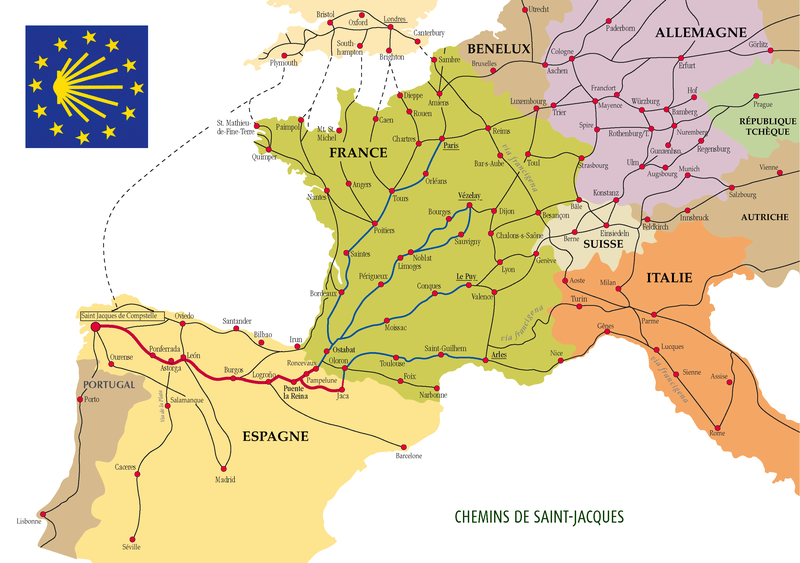
The Way of Saint James/ Le Chemin de Saint Jacques de Compostelle/ El Camino de Santiago (because this is a blog post that really calls for a trilingual title) is a famous European pilgrimage that crosses northern Spain to end at the Cathedral of Santiago de Compostela in the northwestern corner of the country.  Now, there are routes all across Europe that lead to this specific path across Spain, and ultimately to the cathedral, but one of the most famous and the most well-travelled begins in Le Puy, France, a city that I got to visit this weekend.
File:Stjacquescompostelle1.png
Common routes of "The Way" in Europe


Le Puy, France (medieval cathedral and pilgrimage point on the left; statue of the Virgin Mary on a cliff on the right)

"The Way" is a very common and well-known journey to take in Europe, even among the non-religious, who often go for the historical aspect, or merely the adventure.

Interestingly enough, two of my three host families' homes have actually been on The Way, meaning they were on streets that were included in the pilgrimage, and which are marked with the recognizable shell emblem:
File:Muszla Jakuba.svg


If you look on the map of possible routes, you'll notice the stretch of path between Le Puy and Lyon (which is a bit less straight than it appears on the map).  My city, Montbrison, is in between the two, and is considered one of the minor cities on The Way.  My host families have told me that just about every summer, they come across a handful of foreigners (often Swiss or Italian, since this is generally the easiest route for them to take to get to Spain) who are slowly but surely walking their way to Spain.

I personally would love to walk The Way someday.  It's pretty inspiring to see some of these people out there, with nothing but a large backpack and several layers of clothing, braving the weather, the exhaustion, and frustration, all of them acutely aware that the cliché is true- that their journey matters a whole lot more than their destination.  All along The Way, there are also brilliant sites to see: breathtaking cathedrals, castles, ancient cities, and picturesque landscapes.  Don't get me wrong, I've got nothing against city-hopping and seeing the great European capitals, but if you ask me, journeys like The Way sound like the real way to discover Europe.

Last note: there's actually a movie about The Way, conveniently titled The Way.  Look it up if you're interested!  It's some pretty incredible stuff!

Wednesday, April 23, 2014

A taste of home: Basketball games :)

With my brother and sister both being avid basketball players, I naturally spent a decent amount of my life at home sitting on the bleachers, cheering on my siblings and their teammates.  When I Skype with my parents here in France, it's not uncommon for them to tell me the outcome of the latest game(s) and for me to express how much I miss being their to support the team.  Lucky for me, though, this last weekend I got the opportunity to watch not just any youth basketball game- but part of an international tournament, right here in my host city.

The very beginning of the Montbrison vs. Prague game.
 
The game was fantastic- Montbrison was in the lead 51 to 49 with two minutes left, and we ultimately ended up winning 55-51. 
 
Towards the end of the game: Montbrison in red, Prague in blue
 
It might be kind of dumb and cheesy to say this, but I still feel like it needs to be said: you really don't realize how small the world is until you experience something like this.  Maybe not a basketball game in particular, but just being in a foreign country, living a different life, and experiencing something so strangely familiar, and sort of reaching that realization of "Hey, we're all different, but not that different."  I was watching these French and Czech kids play basketball the way I might have watched Hollis and Amherst play.  It was a game, with no visible concern for the language barrier, cultural barrier, social barrier that separated these kids.  They were just a bunch of boys out on the court, doing what they were used to doing, playing the way they always played, united by the quasi-universal language of basketball.
 
It's strange to say, maybe, but it was really kind of incredible and touching for me, even if it was just a game.  It's kind of the same way I feel when I'm spending time with other exchange students.  There's really nothing political about it, and while we certainly don't avoid difficult subjects, there's sort of a mutual indifference toward politics, class issues, economics, and so on.  We're not at all blind to our differences, but we generally all find a way to just respect each other and get over that kind of stuff.  This is really one of the reasons I hope everyone who can will go abroad at some point in their life, or develop a close relationship with someone from a foreign country.  It's important to be to that disagreement, even on major issues, isn't at all a reason to dislike someone or to spend less time with them.  I feel like that's really kind of been a big, overarching message throughout this whole year.  Yeah, we're different, but still, everywhere in the world, there are teenagers who play basketball, and kids counting down the days to their favorite holiday, and friends who will give you a ride home when it's raining, and people who know just what to say to make you feel better.  Everywhere in the world, there are families, and nice people, and not-so-nice people, and funny stories, and embarrassing moments, and those days you wish you could relive forever and ever.  And it's always going to be like that.  It all just fills me with a deep desire to know the world- not just to know about things, but to be there, living them and understanding why things are different and how another way of doing things can be just as valid as the way I'm used to.  I feel like this is really the goal of the entire youth exchange program: not only to immerse us in one culture, but also to give us a deeper understanding of the cultures we are yet to know, and an open-minded interest in them.  It sounds idealist when put this way, but truly, if we ever want to work together to achieve anything in the world, we need to start thinking this way.


Tuesday, April 8, 2014

Rites of Passage

As some of you know, I'm spending my senior year in France in an actual class of French seniors (despite the fact that most exchange students get put in "Junior year" for various reasons... I got switched due to some overcrowding and technical issues), which means I'm here to witness and share in the coming of age of my classmates and friends here in France.  Kind of like in the US, eighteen is the big number in France.  But unlike in America, the eighteenth birthday is really the coming of age for a lot of factors: voting, driving, drinking, etc. and not just becoming a legal adult.

It's actually been kind of funny when I've talked to people in France about "coming of age" in the US- a lot of them think that legal majority comes at twenty-one (they confuse it with the drinking age... which they can't believe comes a full five years after the driving age... I actually find this kind of ridiculous too after spending so long), and people generally find it strange that Americans have so many different points in their adolescence that could be considered rights of passage.  In France, it all gets wrapped up in one package called "eighteen."

Another big thing that happens at eighteen: the bac.  Essentially a massive final exam that determines whether or not a student will graduate high school.  It involves a ton of studying, a challenging senior year, and a huge sigh of relief at the end of it all, when students know that they can finally close that chapter of their life.

...Then comes the next big step: moving out.  Yes, at eighteen.  Not exactly the way we think of it in America, but a big step nonetheless.  Since few French universities have housing for students, college kids rent apartments in the city where their university is located, sometimes in groups, other times alone.  During the week, they are responsible for themselves: taking care of themselves, keeping the place clean, making food, and so on.  Now, the vast majority do come home to Mom and Dad on the weekend (for laundry, "groceries," and family time).  Still, the prospect of being out on their own for the first time is intimidating for a lot of high school seniors. 

I remember one day, during cold and flu season, we wound up with eight people coming to history class, and since it was pointless to move onto new material with a quarter of the class, we sort of just chatted with our extremely motherly history teacher.  A lot of my classmates surprised me by talking about how worried they were about managing on their own and how lonely they would feel- they really were anxious about it!  Oddly enough, before I set out to leave the country all on my own for a year, I hardly felt like that at all; this was my big adventure!  Naturally, I did get homesick and hit rough points, but it was all part of the experience and all totally worth it.

The funny thing about the presence of rites of passage in so many cultures is that they try to pick a moment in time and say "BOOM! You're an adult!" where in actuality, we all know it doesn't work anything like this.  Still, I guess they are important because they force young people to take that leap and start to assume their place in the adult world, whether they like it or not.  My history teacher spent that day comforting the class that their family would always be their family even when they were gone (I mean... about an hour down the road, but still), and that their would be someone around to help with laundry, with cooking, with moral support... until one day when we wouldn't need it anymore.  One day, very soon for some of us, we'll be the ones helping the newcomers.  I think that that's really the significance of these rites of passage: not to claim that something's going to change overnight, but to sort of force us to shed our old skin and grow a new one; to leave behind what we used to be and take the opportunity to become who we want to be.

Wednesday, April 2, 2014

Fun Post: 50 Funny Things I've Been Asked/Told in France

Enjoy :)

1. You're from the United States?  Which one?  Texas, California, or New York?

2. My cousin's neighbor's nephew's girlfriend's piano teacher used to live in Iowa!  Maybe you know her!  She's in her mid-forties, blonde, drives a red car...

3. Do you know any movie stars?

4. Do you know Miley Cyrus?

5. How many times a week do you eat at McDonalds?

6. You're too skinny to be American.

7. Do you have a boyfriend?  Is he a cowboy?

8.  Are you sure you're not Canadian?  Like, really sure?

9.  If you're American, how did you learn French?

10. Have you ever met Obama?

11. Do you like Obama?

12.  Would you have voted for Obama?

13. Why don't all Americans love Obama?

14. Has Obama fixed American healthcare yet?

15. Obama's a handsome president, isn't he?

16. Obama.

17. Do you have orange juice in America?

18. Do people babysit in America?

19. Do you know how to stick your tongue out? Do Americans do that?

20. Have you ever eaten apple pie?  ...No, you definitely haven't, it's French.

21. Do you have lockers in American high schools?

22. Do the football players really date cheerleaders?

23. Are you a cheerleader?  *Kindly pats shoulder* You're pretty enough to be a cheerleader if you
wanted to be.

24. Do you have music classes in America?  Is it like on Glee?

25. Do you carry a gun to school?

26. Do you ride a horse to school?

27. Do the big yellow school buses really exist?

28. Does school really end at 3:00? What do you do after school? (As opposed to the 10-hour French school day)

29. Why do Americans eat so much?

30. Are there vegetarians in America?

31. Are there vegans in America?

32. Are you sure about that?

33. Has your state legalized marijuana?

34. Why not?

35. Aren't a lot of Americans Puritans?

36. Aren't a lot of Americans involved in the Westboro Baptist Church?

37. Well, that's comforting.

38.  What exactly is Thanksgiving?

39. ...And then you killed the Indians???

40. What is college like in America?

41. So, wait, let me get this straight.  The government doesn't pay for your education?

42.  But you can get scholarships?

43.  Like on Glee?

44.  And High School Musical?

45. ...You don't really break into song and dance in the hallways do you?

46. That's disappointing, frankly.

47. So where exactly are you from in America?

48. ... What's New Hampshire?

49. Where's New Hampshire?

50. Oh, so you are Canadian.

Thursday, March 27, 2014

A Night At the Opera!

Hi everyone!  Big announcement!  Emma Close is now an opera-going-girl!  And it was pretty awesome too!

Basically, my school's music class tries to go on a couple of music/arts-related outings every year, and last Tuesday, we got the chance to go out to the St. Etienne Opera to see Jules Massenet's Werther.  I didn't really know what to expect for my first opera, but I was honestly blown away by what I saw and heard.

I'll admit, the story wasn't incredibly original, but I guess I'll forgive them for that ;) . Actually, it kind of had the classic opera plot of: man loves woman, woman is married, man keeps chasing woman around anyway, woman loves him back but tells him to go away anyway, man kills himself and takes a good thirty minutes to sing himself to death in woman's arms.  On Christmas.  With a choir of children singing in the background.  A little cheesy maybe, but the singing made up for it a million times over.  It's absolutely breathtaking to see people put such power into their voice, and to tell an entire story without any spoken dialogue at all.

As I'm told, the opera was based on a German story but written by a French man, so it's sung in French... with French subtitles, since singing opera in French requires some tweaking of the letter "r" and pronunciation of normally silent syllables, plus the fact that it's sung and doesn't follow the normal French pattern of keeping a sentence fairly monotone and raising the voice on the last word or two... all of which can make a totally normal French text sound like... well, Fr-italian, frankly.  Anyway, having the subtitles really helped certain exchange students (especially those who aren't well-versed in opera) understand what was going on.

So, the big conclusion: French opera is pretty awesome.  I highly recommend it.

Thursday, March 20, 2014

Update After the Great Hiatus... Sorry!

Hi again everyone!  Apologies for the several weeks of non-posting; it's all been a bit of a rush!  Basically, I've spent the past three weeks:
  • Exploring Paris and Barcelona by bus with other exchange students
  • Having my REAL DAD coming to visit me
  • Sightseeing in Rome with said REAL DAD (and making my mom extremely jealous- I'll be home soon, Mom!!!)
  • Changing host families (for the last time this year!)
  • Settling back into school routines after winter vacation
... All while attempting to chip away at scholarships a little bit. :P

So, you can see that I've been busy!  Since I'm tired tonight, I figured I'd just put up a couple of pictures from my recent adventures, and then do a proper blog post soon.  Here we go:


Eiffel Tour with my Rohit, my Indian friend, and Jacques, my counselor and one of our chaperones.


First floor of the Eiffel Tower with some friends :)


(My phone's not being very cooperative right now, but I promise I'll be putting some other pictures up as soon as I can get them onto my computer!  Anyway, just wanted to show you I've emerged from my epoch of non-blogging darkness :P)

Thursday, February 27, 2014

On the Social Hierarchy (Or Lack Thereof)

So, my philosophy class has just finished studying Of the Social Contract, a book in which the author, Rousseau, essentially denounces the whole idea that the monarchy and social hierarchy of 18th century Europe are natural, and destined by God, inherently flawless, etc. and says that society actually has a duty to be, well, functional and reasonable, unless they want their population to freak out and start a revolution (which they have the right to do).  Anyway, all this talk about various societal hierarchies and class systems has gotten me thinking about the social hierarchy within a high school, and it's presence in America versus its apparent absence in France.

In general, I love it when people here ask me questions about America- largely because I can show them that all those preconceived ideas and stereotypes of Americans are oversimplified, misleading, or even completely untrue: and all those questions like "Do you eat at McDonald's all the time?"  "Do you know any movie stars?" "Do you carry a gun to school?" and of course, "If you're American, how did you learn French?  Americans don't speak other languages..."

When I talk to other high school students, though, the question inevitably comes up: "Are American high schools really the way they look on TV?"  When people first started asking me this, I tended to laugh it off a bit.  No, we don't break out into song and dance between class periods.

Then, I inevitably got the response: "No, not like that.  I mean, with the sports kids and the music kids and the kids who study too hard, and the cheerleaders who date the football players, and the popular girls who talk about everyone else, and the weird kids who get picked on, and the shy kids that just try to stay out of everyone's way..." and so on.  I always had to hesitate for a moment before answering.  Of course that's all exaggerated and blown out of proportion on TV, but, compared to the French, who lack just about all of this... yeah, American high school is kind of like that.

It's so easy to categorize American high school students; it's almost as if they want to be categorized.  Who hasn't looked at someone, at least once in their life, and immediately thought "What a nerd/jock/airhead/tramp/druggie/etc."  ...In France, it's just not like that.  People are weird, basically.  They don't fall into categories and they don't really form cliques.  Yes, everyone has their circle of friends, but they're much more fluid and much less... at war with each other.  Plus, I've often been surprised by who's friends with who here.  On top of it all, there's so much more of a sense of community here, and the fact that people go to school together, live near each other, and care about each other just transcends the lines of any would-be cliques.  Who would have guessed that the just-so girl at the top of our class is the lifelong friend of the overly-artsy kid with tattoos and dreadlocks?  Or that the class clown may have saved the life of the philosophy/classical music lover by getting her into suicide prevention?  That a class of twenty entirely different personalities embraced with open arms an exchange student in need of a friend?  Maybe I sound like I'm romanticizing it a little here, but I truly think it's a beautiful thing, and really wish American students could take a lesson from the French here.

All that being said, I also talk to my French classmates quite a lot about other aspects of American high school, explaining that those magical foreign things like school sports teams, musical/theatrical productions, student newspaper, and (of course) prom really do exist.  Just about all my classmates have expressed an interest in that sort of thing, complaining that in France, school is just school, and that it really should be run more like a community, since (for better or for worse) it's pretty much the center of a teenager's world.  And honestly, I agree with them... even though I never really showed a whole lot of interest in that sort of stuff back in the US.  Maybe it's a simple case of not appreciating what you have until it's gone, but I feel like it's something more.  I (ironically) feel more a part of my French school than I did in my American one.  People get along here.  It's a pleasure being around these people (nearly) 24/7.  They're the sort of people that I'd want to be teammates with, that I'd want to watch perform, that I'd want to spend a night dancing with.  Don't get me wrong, I had brilliant friends in America (who I miss terribly!), but I didn't at all see myself as a significant part of the school community.  It was as if these events weren't meant for people like me.  There was a very distinct line between us and them, that people rarely (if ever) crossed.  And looking back, I often regret not trying to cross it.  It doesn't seem like such a difficult thing to do.

I feel like American high school needs an attitude change.  We have the capability to be really close to the people we live and learn alongside, if we'd just make an effort to reach out to each other and stop hiding in those cliques where we tell ourselves we belong.  Of course we don't all have to be best buddies; everyone has people they like and don't like.  But it's stupid to think that everyone can only have one type of friend, or that their friends have to look, act, dress, and talk like them.  Are we really that shallow?  Aren't we better than that?

Sunday, February 23, 2014

Something Important

I know I might be cheating this blog post a little by not talking about France, and not even using my own words, but this is something that I needed to post- a message that I needed to send- for the sake of the international community that I now know I am a part of, and especially for my Venezuelan friend Lorena.  Though she's currently here in France with me, it's still incredibly difficult for her to live day to day life while conscious of the terror that's facing her family, her friends, and her country.  I'm not really sure what I want to accomplish with this post; I just want people back in little old New Hampshire (or wherever else you may be reading this) to be aware of what's going on right now, and to realize that we're all connected in one way or another.  What affects some of us ultimately affects all of us, and it's wrong to turn a blind eye to things that "don't involve me."  Please, just do me a favor and read:
http://www.bbc.co.uk/news/world-latin-america-26309917
http://edition.cnn.com/2014/02/22/world/americas/venezuela-socialism/

Photo : 󾬕󾬓❤️

Saturday, February 8, 2014

Being American in a French School's English Class... Oh my...

Hi everyone.  Just thought I'd take a moment to share something that happened the other day in my entertaining, ever-fascinating English-as-a-second-language class (no sarcasm here, I swear! ;-) ).

Our class recently took the French equivalent of midterm exams, and rather than having me do the English exam in French (as I normally do, to practice my second language along with everyone else), the teacher asked me to do the essay section in English, so that she could give it to the class as an example.  I agreed, and wrote the assigned essay on the topic "Could you still consider someone your hero, even if you didn't agree with their political opinions or personal life?"  I essentially answered yes, backing my argument up with a few simple points about how no one is perfect, even our "heroes," and we could still respect someone's accomplishments without necessarily agreeing with every aspect of their behavior.

About two weeks later, my English teacher had corrected all the exams and was passing them back to the class... all while giving advice on how to write a better argumentary essay on why someone with disagreeable political opinions or personal behaviors couldn't be our hero.  That's right.  I was the only one in the class of twenty-some who took the other side of the argument.  And no, it wasn't because I was a native speaker and I felt capable of taking "the harder side;" it was what I genuinely believed.  And, as I asked around, I found that my classmates genuinely believed that they couldn't call someone their hero if there was something they found blatantly disagreeable about that person's private life.  For them, the essay prompt had been clearly one-sided, and apparently, my English teacher had intended it to be one-sided as well.  She actually pulled me aside at the end of class to say that I hadn't written the essay she'd expected me to write at all.  She said she'd still give it to the class as a sample essay, even though the content wasn't really the same as what the other students had written. In the end, she thanked me for doing the assignment in English, and then made a bit off an off-hand comment about how "American" I am, to write an essay that takes the perspective mine did.

...Which brings me to my question: Is that really such an American thing to do?  I, like many people in my home country, was raised with the idea that everyone does both good things and bad things, and in the long run, it's not always easy (or possible) to try and sort people into piles of "good people" and "bad people."  I mean, a massive portion of our classic American heroes have what could be considered fundamental moral flaws (George Washington owned slaves since age eleven; Christopher Columbus can take a lot of the blame for the earliest Native American exterminations... besides the fact that he hardly "discovered" America; Thomas Jefferson made money smuggling rum into the colonies when it was illegal... the list goes on and on) and while we might personally dislike these "heroes," I truly don't think that changes the fact that they've had a massive impact on history.  I really hadn't thought of this perspective as being something uniquely American until I found out that the rest of my class didn't share this opinion... Anyway I found this guy from "Humans of New York" who sums it up nicely:

"I can't stand moral absolutism. You know, there's always that guy who wants to point out that Martin Luther King cheated on his wife-- as if he obviously couldn't have been a great person if he did something like that. Or someone will bring out an inspirational quote, and get you to agree, and then inform you that Hitler said it. As if a good thought couldn't come from Hitler. Moral absolutism keeps us from learning from the past. It's easy to say: 'Hitler was a demon. Nazis were all bad seeds.' That's simple. It's much harder to say: 'Is that humanity? Is that me?'"
-Humans of New York, January 2, 2014

Sunday, February 2, 2014

A Festival of "Many Sounds"

... Alternatively titled, "why American pop music really bugs me sometimes."

I enjoy a catchy tune as much as anyone else, and popular American music really does a very good job of delivering that.  French teenagers like American music too, and most of them will generally agree with my previous statement.  The funny thing is, in France, American music is the stuff that gets blasted out of speakers at parties, the stuff you listen to while working out, the stuff on the radio when you drive to work. But if your go to a concert, and pay, and sit down in a theater with the intention of listening to music... it'll be in French.

My hypothesis for the French's interesting relationship with American music?  They like it because they aren't really paying attention to it, and because they don't understand the lyrics.

I have to side with the French on this one, American pop music is great to play in the background at parties, and great to listen to while killing time, but, with a few notable exceptions, popular American music generally consists of a whole lot of the same thing.  It's repetitive, unexceptional, and frankly uninteresting a decent portion of the time.  I'm not calling it bad music by any means, since I like singing along to catchy refrains as much as the next guy.  I'm just saying it's not particularly different, and not particularly meaningful.

My local theater in France has an annual "Festival of Many Sounds" in which young, undiscovered musicians or groups come and perform onstage to help get their name out there.  There are generally about four groups per venue, and the music (as the name of the festival suggests) tends to be very diverse, even within one show. 

The night that I attended:
  • A soloist with a tape recorder on repeat, which allowed her to record herself and (in a weird sort of way) accompany herself through several songs
  • A high-energy rap group that involved beat-boxing, a clarinet, and a sousaphone
  • Two teenagers with acoustic guitars and angelic voices
  • And a hard-rock French screamo band
... And they were all incredible.  Though I was at a concert for "undiscovered" musicians, I feel like I need to express that groups like these CAN and DO succeed in France.  I'm not sure if it makes sense to say it like this, but I feel like French musicians can take more risks with their music, in a sense.  In other words, sounding like popular musicians doesn't mean (or even suggest) that you'll become a popular musician, unlike the way it seems to be in America.  I find French music weirder than American music- more diverse, and more intriguing.  It's a sound that sort of forces you to listen, rather than just a jingle that plays in the background.

Long story short, American pop music tends to be entertaining; French music tends to be meaningful, and often heavier.  I personally feel like there's a time and place for each, and see French music as a friendly reminder that there's more out there than those six songs the popular radio station plays on repeat- the point of music is to say something that words alone sometimes can't express, and not to imitate the other pop stars just to make a dollar.  I think it's high time American music started living this philosophy.

Monday, January 20, 2014

St. Etienne's Cathedral- Bourges

Hi again, everyone!  This past weekend I got a really awesome opportunity to travel to Bourges, a very old city right in the center of France, and visit one of the most beautiful cathedrals in the world.

carte france bourges

204 bourges cathedrale interieur canon

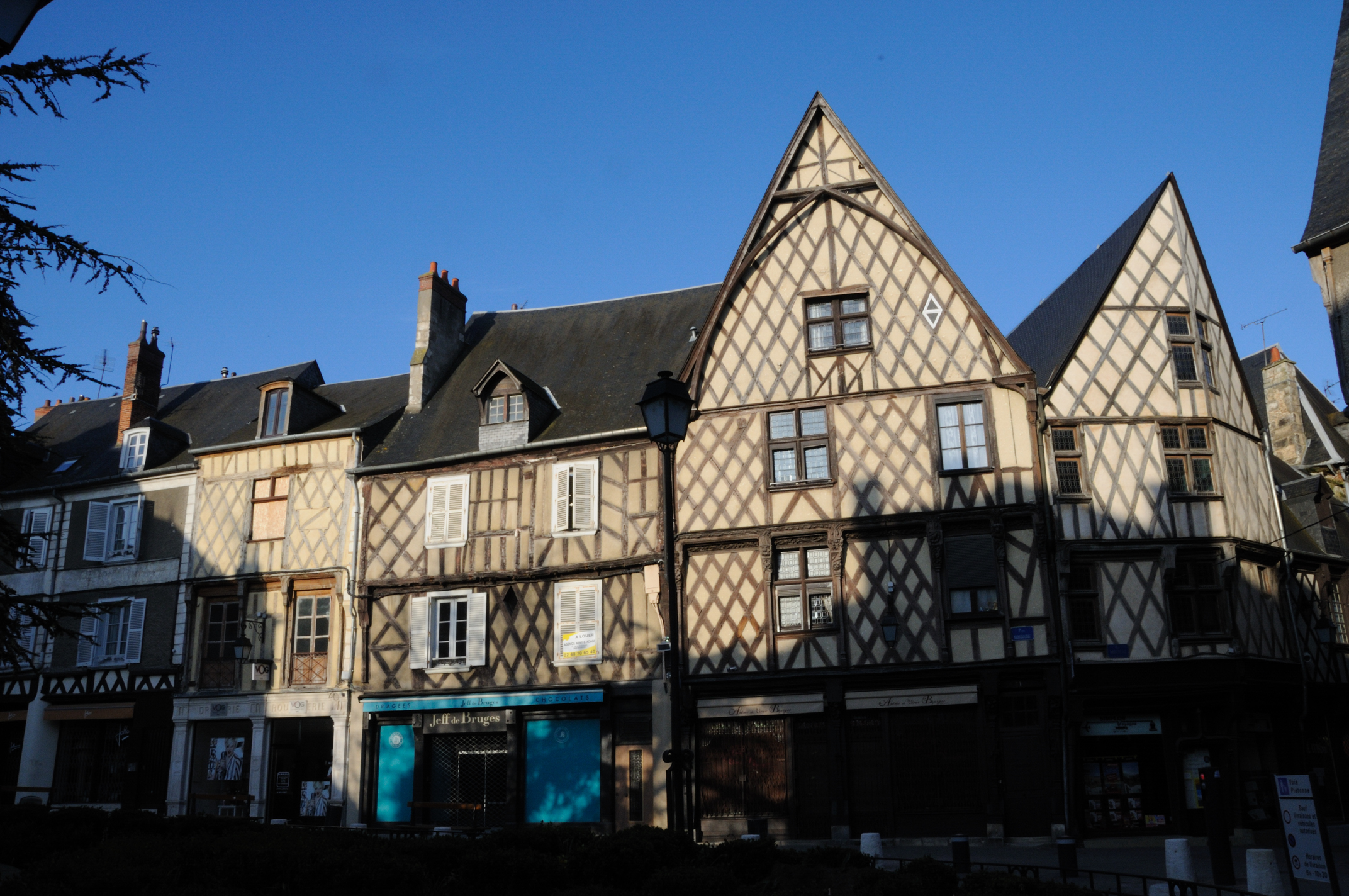
The city of Bourges is absolutely ancient, and was written about in records of the Gallo-Roman Wars (Julius Caesar's time!).  Even today, an astonishing amount of medieval architecture remains- everything from the cathedral to a nearby palace to everyday "peasant" houses that are still inhabited today.


The construction of the cathedral itself began in the 1100's, and was consecrated in 1324. Throughout its existence, the cathedral has been home to a serious of bishops and archbishops, and is today the religious center of the region.  Like many elaborate French cathedrals, St Etienne of Bourges took a beating in the Wars of Religion, though unlike many other cathedrals, St Etienne's Cathedral was able to preserve a decent amount of partially destroyed statues.  Today, these statues and other original decorations are housed in a crypt beneath the cathedral, open to tourists.  It was absolutely amazing to see all of these ancient pieces, many dating back to the 12th, 13th, or 14th centuries (left in their original state, never touched-up or altered), and some which have even maintained their original paints and varnishes (contrary to popular belief, these medieval cathedrals were originally quite colorful- white statues and uncolored religious decoration is quite a modern trend).  Anyway, most of these semi-destroyed pieces of art are decapitated saints, who lost their heads to some angry protestants (and some other people who got involved purely for political reasons) during the French Wars of Religion in the 16th century.


^^^ Remarkably well preserved tableau/statues representing the crucifixion.  This piece dates back to about 1230-1240, and has not been altered or revarnished since it was moved to the crypt for protection during the Wars of Religion.  Our tour guide mentioned that the Roman soldier's head and helmet look incredibly modern, but were indeed a part of the original tableau.


The depths of Hell (I think?  Either that, or a bunch of people being cooked in a cauldron for some reason...) from approximately the same time period.

Overall, this place is historically and artistically awesome, and a must-see for anyone who ever finds themselves in France!

Wednesday, January 8, 2014

La Galette des Rois

Happy New Year, everyone!  It's hard to believe it's 2014 already... so much has changed in the past year, the past months... and I'm hoping that the coming year will bring just as many surprises, challenges, and success stories! :)

Anyway, I'm posting today to share another French holiday tradition, the Galette des Rois (Cake of the Kings).  This tradition is typically carried out the Sunday following Christmas.  French families bake or buy a sort of cake (I say cake because there's no true English translation for "galette."  It's kind of closer to a pie, with a custard-y, cake batter-y almond filling.  And it's tasty.  Very tasty.), with a little porcelain bean baked inside.  The cake is cut into pieces and distributed by the youngest member of the family.  Then, everyone eats, and the person who finds the bean in their slice is crowned king or queen for the day.


The tradition of the Galette des Rois was originally celebrated at the Epiphany to commemorate the visit of the magi (hence the crowning of a king/queen), and is known to have existed since at least the 14th century.  Fun fact: During the French Revolution (and approximately the half-century of... interesting politics that followed), the Galette des Rois was renamed the "Gateau d'Egalite" (Equality Cake) since the whole concept of kings had become a bit unpopular (sort of the same idea as Americans renaming sauerkraut "liberty cabbage" and things like that during World War II).  The Galette earned back it's original name in the mid-1800s.

Anyway, this is my tradition to share this week.  Hoping that everyone at home is enjoying their own holiday traditions!  Joyeuses Fetes!