The holidays in France have been pretty great so far, and quite different from the holiday season back home in America. For starters, being away from home has kind of made me realize that Americans tend to celebrate December itself as the holiday season. In other words, the anticipation and the days and weeks leading up to Christmas are sometimes more exciting than Christmas itself. Then, afterwards, you kind of get that December 26th feeling, when it's strange to think that everything is suddenly over.
In France, it's just the opposite. The weeks leading up to Christmas are nothing special, except that they normally involve making plans for the holidays. Christmas itself begins on Christmas Eve, with a midnight mass and a buche de Noel, a special French Christmas dessert. Then, the next few days involve travelling to see family, or inviting relatives over, and feasting on Christmas food. The French don't really have any holiday equivalent to the American Thanksgiving, or any holiday celebrated mainly for food, so Christmas kind of takes that place. The festivities then last until New Year's Eve/Day, which is much more celebrated in France than it is in America. It's actually considered sort of a second Christmas, the major difference being that Christmas is a holiday spent with family and New Year's is a holiday spent with friends.
The holidays are naturally a time that can be kind of difficult for exchange students, since it involves missing family traditions and being forced to accept new ways of celebrating a special time of year, and I've heard a lot of exchange students from North and South America complaining that the French holidays are under-celebrated. Though things are certainly different here, I have to disagree. The French holidays, like I've already said, are celebrated in a bit of a different time frame, and they are, admittedly, significantly under-commercialized. There are fewer gifts, fewer holiday sales, fewer holiday commercials, etc., and I've appreciated that. Though it's not quite the Christmas I'm used to seeing in America, it's nice to see Christmas recognized as a holiday about family. I feel like that's something that sometimes (not always, but sometimes) gets lost in the stress and extravagance of the American holiday.
Saturday, December 28, 2013

Saturday, December 21, 2013
La Fete des Lumieres
Hello again, everyone! It's been kind of a hectic past few weeks, and the time is really starting to get away from me, so I apologize for being a little negligent about my blogging. Fortunately, I'm on Christmas vacation for the next two weeks, so I've got a bit of time to catch up.
For this post, I'd like to talk about one of the biggest pre-Christmas celebrations in France- and one that I was lucky enough to see in person: Lyon's Fete des Lumieres (Festival of Lights).
On December 8th of every year, the entire city of Lyon lights up with artistic displays and animated spectacles. The festival attracts over four million tourists annually, and it's easy to see why! Light shows are planned months in advance to be absolutely breathtaking on the day of the festival.


Though the vast majority of the spectacles on display in Lyon are accomplished through modern technology, the Fete des Lumieres itself actually dates back to the Middle Ages, when France was struck by the bubonic plague. The city officials and priests prayed to the Virgin Mary to spare Lyon from the disease, which she did. In the following years, inhabitants of Lyon established a tradition of placing candles in their windows in early December, as a sign of gratitude. Then, around the late nineteenth and early twentieth century, the tradition began to grow into a true spectacle. Store owners put up displays using moving electric lights, and the festival has been growing every year since. Today, the Fete des Lumieres exists not only in Lyon, but in many other major French cities as well. Lyon, however, remains the cultural home of the festival of lights.
For this post, I'd like to talk about one of the biggest pre-Christmas celebrations in France- and one that I was lucky enough to see in person: Lyon's Fete des Lumieres (Festival of Lights).
On December 8th of every year, the entire city of Lyon lights up with artistic displays and animated spectacles. The festival attracts over four million tourists annually, and it's easy to see why! Light shows are planned months in advance to be absolutely breathtaking on the day of the festival.
Though the vast majority of the spectacles on display in Lyon are accomplished through modern technology, the Fete des Lumieres itself actually dates back to the Middle Ages, when France was struck by the bubonic plague. The city officials and priests prayed to the Virgin Mary to spare Lyon from the disease, which she did. In the following years, inhabitants of Lyon established a tradition of placing candles in their windows in early December, as a sign of gratitude. Then, around the late nineteenth and early twentieth century, the tradition began to grow into a true spectacle. Store owners put up displays using moving electric lights, and the festival has been growing every year since. Today, the Fete des Lumieres exists not only in Lyon, but in many other major French cities as well. Lyon, however, remains the cultural home of the festival of lights.
Friday, December 6, 2013
Teaching History in France
Hi everyone!
So, after being in French high school for several months now, I thought it might be a good time to put up a post on some of the differences between French and American schools. As I was writing this, though, one class kept coming to mind as a big difference between the two countries: history class.
As much as we like to pretend students learn facts, people, places, and dates in history class, there's a point at which we have to admit that history is much, much more subjective than we sometimes make it out to be, and the way in which it's taught can differ drastically in two different locations- even in two democratic, industrialized, first-world countries like the US and France.
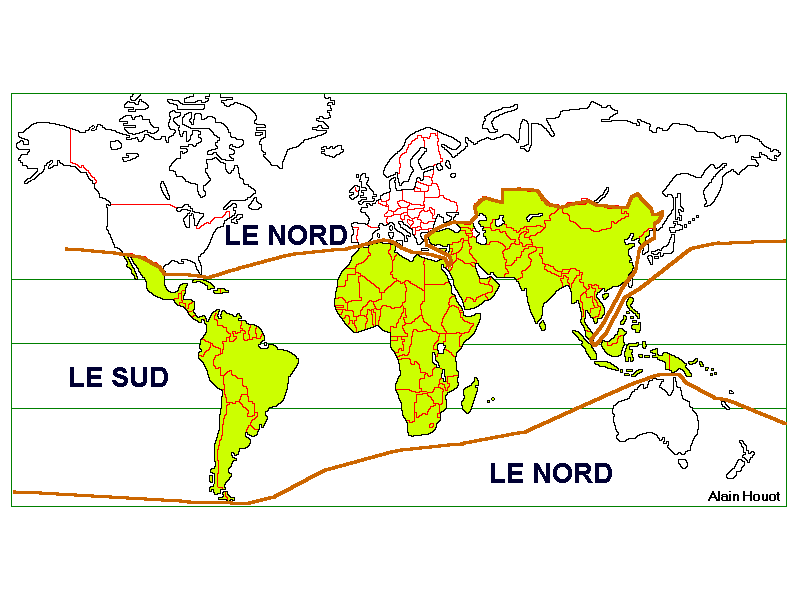
First of all, in France, students don't identify countries in terms of "Western countries," "Eastern countries" or first, second, or third-world countries. They talk about "the northern world" and "the southern world" divided by an imaginary (and in my opinion, rather arbitrary) line that runs along the Mexican-American border, across the ocean, between Europe and Africa, and continues along Russia's southern border all across Asia. With this line, French students distinguish the wealthy, developed "northern world" from the generally poor, underdeveloped "southern world." At first glance, I disliked this categorization of the world; it seemed overgeneralized to me, and I was annoyed that these students were being taught such a black and white view of the world.
After being in the class for a while, though, I'm starting to see the genius of it. The northern/southern categorization isn't used to show a clear split between the rich and the poor, developed and undeveloped; actually, it does just the opposite. Senior year history in France focuses on recent world history. Generally from the mid/late cold war to modern day, with emphasis on globalization and its impact on the world. That's where the northern/southern line comes in. Historically, it has been possible to classify the world in such black and white terms. Even before the cold war, less than a hundred years ago, one could pretty easily sort every country in the world into a "developed" or "undeveloped" category, and the barrier between the developed and undeveloped ran roughly along this north/south line students are taught in school today. In the twenty-first century, with globalization on the rise and the world becoming ever more interconnected and interdependent, this is no longer the case.
Some of the tests we take in history class are "map tests," and are nothing like a history test I ever took back at home. On these tests, we're asked to color code a map based on GDP, life expectancy, even the number of iPhones per capita- and using these telling demographics, we examine which countries are inconsistent with the traditional north/south split and why our color-coded maps look the way they do. It's actually quite fascinating.
Also, now that my French has gotten a lot better since I first showed up here, I'm participating a lot more in class too- and I think both my teacher and classmates are genuinely interested in what I have to say. I've already given myself a mental pat on the back for at least having some idea of what's going on in my country (many exchange students, and many high school students in general, really don't...), which has allowed me to (diplomatically) explain to my class America's position on intervention in Syria, and after which, my history teacher said she was impressed by my knowledge and that she wanted to take a few minutes in class some other time to have me talk to my classmates about September 11th and its consequences on America.
Long story short, it's fun and eye-opening to see the way another country perceives history and geography, and people everywhere generally do appreciate hearing another perspective on world events and conflicts. In a class full of interested, open-minded peers, it's good to be an exchange student. :)
So, after being in French high school for several months now, I thought it might be a good time to put up a post on some of the differences between French and American schools. As I was writing this, though, one class kept coming to mind as a big difference between the two countries: history class.
As much as we like to pretend students learn facts, people, places, and dates in history class, there's a point at which we have to admit that history is much, much more subjective than we sometimes make it out to be, and the way in which it's taught can differ drastically in two different locations- even in two democratic, industrialized, first-world countries like the US and France.
First of all, in France, students don't identify countries in terms of "Western countries," "Eastern countries" or first, second, or third-world countries. They talk about "the northern world" and "the southern world" divided by an imaginary (and in my opinion, rather arbitrary) line that runs along the Mexican-American border, across the ocean, between Europe and Africa, and continues along Russia's southern border all across Asia. With this line, French students distinguish the wealthy, developed "northern world" from the generally poor, underdeveloped "southern world." At first glance, I disliked this categorization of the world; it seemed overgeneralized to me, and I was annoyed that these students were being taught such a black and white view of the world.
After being in the class for a while, though, I'm starting to see the genius of it. The northern/southern categorization isn't used to show a clear split between the rich and the poor, developed and undeveloped; actually, it does just the opposite. Senior year history in France focuses on recent world history. Generally from the mid/late cold war to modern day, with emphasis on globalization and its impact on the world. That's where the northern/southern line comes in. Historically, it has been possible to classify the world in such black and white terms. Even before the cold war, less than a hundred years ago, one could pretty easily sort every country in the world into a "developed" or "undeveloped" category, and the barrier between the developed and undeveloped ran roughly along this north/south line students are taught in school today. In the twenty-first century, with globalization on the rise and the world becoming ever more interconnected and interdependent, this is no longer the case.
Some of the tests we take in history class are "map tests," and are nothing like a history test I ever took back at home. On these tests, we're asked to color code a map based on GDP, life expectancy, even the number of iPhones per capita- and using these telling demographics, we examine which countries are inconsistent with the traditional north/south split and why our color-coded maps look the way they do. It's actually quite fascinating.
Also, now that my French has gotten a lot better since I first showed up here, I'm participating a lot more in class too- and I think both my teacher and classmates are genuinely interested in what I have to say. I've already given myself a mental pat on the back for at least having some idea of what's going on in my country (many exchange students, and many high school students in general, really don't...), which has allowed me to (diplomatically) explain to my class America's position on intervention in Syria, and after which, my history teacher said she was impressed by my knowledge and that she wanted to take a few minutes in class some other time to have me talk to my classmates about September 11th and its consequences on America.
Long story short, it's fun and eye-opening to see the way another country perceives history and geography, and people everywhere generally do appreciate hearing another perspective on world events and conflicts. In a class full of interested, open-minded peers, it's good to be an exchange student. :)
Thursday, November 28, 2013
Thoughts on French (and Thoughts in French)
Well, it's pretty much official at this point: I think in French. I still can think in English, of course, but deciding to do that is a conscious decision. Ninety percent of the time here, when a thought pops into my head, it's in French.
This slow but sure language transition over the past few months has actually given me a really unique opportunity to see my native language from an outside perspective, to really look objectively at the structure of the language, and to question why we say things the way that we do. Seeing English this way has been really fascinating, and has actually led to a couple of bizarre moments when I've realized that the way we construct phrases and sentences is actually rather illogical at times (Why do we say "make a speech" instead of "do a speech"? Why can "I would" speak about something in the past or in the future (as in "I would have done it yesterday if I had known" and "I would love to go to the movies tomorrow)? Why on earth do we tack seemingly random prepositions onto the ends of verbs- as in, mess UP, write DOWN, talk someone INTO something, etc.). Speaking from a grammatical perspective, English is kind of a funky language because it has Anglo-Saxon (Germanic) roots, but has taken a significant amount of its vocabulary and some of its syntax from Latin and the modern Romance languages, making it a sort of hybrid language that, frankly, doesn't really bother to follow its own rules.
Another interesting part of this whole language transition has been noticing which factors I have to pay attention to when speaking French versus what I have to pay attention to when speaking English. Genders have been a big part of this. To talk about possession in English, it's important to know the gender of the owner, while in French, the owner's gender makes no difference (i.e. In English we make the distinction between "his books" and "her books," while in French, both would be translated as "ses livres"). On the other hand, speaking French means I have to keep in mind the genders of nouns to construct grammatically correct sentences (to continue the same example, English speakers keep the possessive adjective "his" to talk about "his book" and "his car," whereas the French change the adjective to agree with the gender of the noun: "son livre" and "sa voiture" respectively.)
Aside from simply grammatical differences in the two languages, speaking French has also forced me to adopt something of a second personality. It's not terribly different from my personality in English, so I guess it's not really as if there's a distinct "French Emma," but even so, my manners of speech and behavior are quite a bit different in French. First of all, I have much less of a filter when it comes to showing emotion. That might be partially because being away from home has made me, well, a little more emotionally volatile. But even when listening to other people speak to me, I'll often mimic their facial expressions (sometimes without realizing it) and have noticeable, physical reactions when they tell me something sad, exciting, confusing, etc. to show that I'm listening and that I understand. My sense of humor is also a bit different in French. When telling jokes or funny stories, I tend to speak with a lot of gestures, and make appropriate facial expressions to clarify what's going on. I also have to tell stories like these more slowly, since, if I go too fast and/or start to laugh, my accent kicks in big time and I can be really difficult to understand.
I'm definitely of the opinion that speaking a second language can alter the way one thinks and behaves, not necessarily making the speaker different than they were in their native language; perhaps a foreign language just forces me to express another side of myself. That being said, I'm really happy that I've progressed in French the way I have, if only to have a personality in French. In my first few weeks here, my French was largely practical: asking questions, explaining things that were different for me, letting people know how I was doing, etc. Now, I've finally reached a point where I'm not just capable of communicating in French, but also chatting in French, debating in French, complaining about homework, making plans for the weekend, having philosophical conversations, and truly living in my second language. I've been working toward bilingualism for a long time now; now, I know that it's all been worth it.
This slow but sure language transition over the past few months has actually given me a really unique opportunity to see my native language from an outside perspective, to really look objectively at the structure of the language, and to question why we say things the way that we do. Seeing English this way has been really fascinating, and has actually led to a couple of bizarre moments when I've realized that the way we construct phrases and sentences is actually rather illogical at times (Why do we say "make a speech" instead of "do a speech"? Why can "I would" speak about something in the past or in the future (as in "I would have done it yesterday if I had known" and "I would love to go to the movies tomorrow)? Why on earth do we tack seemingly random prepositions onto the ends of verbs- as in, mess UP, write DOWN, talk someone INTO something, etc.). Speaking from a grammatical perspective, English is kind of a funky language because it has Anglo-Saxon (Germanic) roots, but has taken a significant amount of its vocabulary and some of its syntax from Latin and the modern Romance languages, making it a sort of hybrid language that, frankly, doesn't really bother to follow its own rules.
Another interesting part of this whole language transition has been noticing which factors I have to pay attention to when speaking French versus what I have to pay attention to when speaking English. Genders have been a big part of this. To talk about possession in English, it's important to know the gender of the owner, while in French, the owner's gender makes no difference (i.e. In English we make the distinction between "his books" and "her books," while in French, both would be translated as "ses livres"). On the other hand, speaking French means I have to keep in mind the genders of nouns to construct grammatically correct sentences (to continue the same example, English speakers keep the possessive adjective "his" to talk about "his book" and "his car," whereas the French change the adjective to agree with the gender of the noun: "son livre" and "sa voiture" respectively.)
Aside from simply grammatical differences in the two languages, speaking French has also forced me to adopt something of a second personality. It's not terribly different from my personality in English, so I guess it's not really as if there's a distinct "French Emma," but even so, my manners of speech and behavior are quite a bit different in French. First of all, I have much less of a filter when it comes to showing emotion. That might be partially because being away from home has made me, well, a little more emotionally volatile. But even when listening to other people speak to me, I'll often mimic their facial expressions (sometimes without realizing it) and have noticeable, physical reactions when they tell me something sad, exciting, confusing, etc. to show that I'm listening and that I understand. My sense of humor is also a bit different in French. When telling jokes or funny stories, I tend to speak with a lot of gestures, and make appropriate facial expressions to clarify what's going on. I also have to tell stories like these more slowly, since, if I go too fast and/or start to laugh, my accent kicks in big time and I can be really difficult to understand.
I'm definitely of the opinion that speaking a second language can alter the way one thinks and behaves, not necessarily making the speaker different than they were in their native language; perhaps a foreign language just forces me to express another side of myself. That being said, I'm really happy that I've progressed in French the way I have, if only to have a personality in French. In my first few weeks here, my French was largely practical: asking questions, explaining things that were different for me, letting people know how I was doing, etc. Now, I've finally reached a point where I'm not just capable of communicating in French, but also chatting in French, debating in French, complaining about homework, making plans for the weekend, having philosophical conversations, and truly living in my second language. I've been working toward bilingualism for a long time now; now, I know that it's all been worth it.
If you talk to a man in a language he understands, that goes to his head. If you talk to him in his language, that goes to his heart.
Nelson Mandela
Read more at http://www.brainyquote.com/quotes/authors/n/nelson_mandela.html#MXRobMm81bpiQ4WV.99If you talk to a man in a language he understands, that goes to his head. If you talk to him in his language, that goes to his heart."If you talk to a man in a language he understands, that goes to his head. If you talk to a man in his language, that goes to his heart." ~Nelson Mandela
Read more at http://www.brainyquote.com/quotes/quotes/n/nelsonmand121685.html#KaWGWxol2D4UcKSr.99
Sunday, November 17, 2013
Walking versus Driving
Well, we all knew it was coming at some point... so here's my first weird rant on a completely random cultural topic: everyday transportation.
The French don't drive the way Americans do, and especially not the way we do in southern New Hampshire (where I take a ten minute drive in one direction to go to school, a twenty five minute drive in the opposite direction to go to swim practice, an hour's drive north for exchange student orientations, about an hour south to get to the region's largest city, et cetera). Nope. In France, you have all your basic amenities like food, clothing, school, and sports within walking distance, and everything else is a road trip.
This is truly the first time in my life where I've lived within walking distance of just about anything, and I have to say, I like it a lot. It's really nice just to be able to take a stroll through town when it's nice out, and having some independence with walking has kind of taken the edge off of the fact that I can't drive in this country (kind of... ;) ). Residents of Montbrison don't consider the town anything special, since it's a pretty average town for the French. I, on the other hand, have lived here three months and still haven't gotten over the thrilling fact that I'm free to roam around, checking out cafes and boulangeries at my leisure, whenever I have nothing else to do after school or on weekends.
The French view on driving has admittedly been harder to get used to. In my New Hampshire/Vermont Rotary district at home, it was normal for host parents to have to take their exchange student sometimes several hours' drive from home for exchange student functions, which happen about once a month. Here, it's been a pretty significant complication every time I need to attend a Rotary event in Lyon (about an hour away), and so far I've always needed to contact my local Rotary members to see if someone can give me a ride. There are a significant number of people in Montbrison who don't own a car at all, and get by solely by foot, by bus, or by train- something that's just not all that possible in Hollis or Brookline.
Speaking of buses and trains, I've actually taken each one twice since I've been here, and found them both impressively safe, clean, and on time. I can certainly see how locals here can use them as primary means of transportation. Honestly, I think they're both kind of fun, since I never have the opportunity to take public transport (other than school buses) at home. Doing something like that can sort of make you feel like you're someplace truly different- which I certainly am!
The French don't drive the way Americans do, and especially not the way we do in southern New Hampshire (where I take a ten minute drive in one direction to go to school, a twenty five minute drive in the opposite direction to go to swim practice, an hour's drive north for exchange student orientations, about an hour south to get to the region's largest city, et cetera). Nope. In France, you have all your basic amenities like food, clothing, school, and sports within walking distance, and everything else is a road trip.
This is truly the first time in my life where I've lived within walking distance of just about anything, and I have to say, I like it a lot. It's really nice just to be able to take a stroll through town when it's nice out, and having some independence with walking has kind of taken the edge off of the fact that I can't drive in this country (kind of... ;) ). Residents of Montbrison don't consider the town anything special, since it's a pretty average town for the French. I, on the other hand, have lived here three months and still haven't gotten over the thrilling fact that I'm free to roam around, checking out cafes and boulangeries at my leisure, whenever I have nothing else to do after school or on weekends.
The French view on driving has admittedly been harder to get used to. In my New Hampshire/Vermont Rotary district at home, it was normal for host parents to have to take their exchange student sometimes several hours' drive from home for exchange student functions, which happen about once a month. Here, it's been a pretty significant complication every time I need to attend a Rotary event in Lyon (about an hour away), and so far I've always needed to contact my local Rotary members to see if someone can give me a ride. There are a significant number of people in Montbrison who don't own a car at all, and get by solely by foot, by bus, or by train- something that's just not all that possible in Hollis or Brookline.
Speaking of buses and trains, I've actually taken each one twice since I've been here, and found them both impressively safe, clean, and on time. I can certainly see how locals here can use them as primary means of transportation. Honestly, I think they're both kind of fun, since I never have the opportunity to take public transport (other than school buses) at home. Doing something like that can sort of make you feel like you're someplace truly different- which I certainly am!
Monday, November 11, 2013
Armistice Day in France
Hi everybody, and happy Veterans Day to all my American friends! Here in France, it's Armistice Day (more or less the same holiday, more or less the same purpose, just a different name), and I'm getting the opportunity to experience rather different cultural views on a national holiday.
First, a bit of history. Veterans Day in America and Armistice Day in a whole bunch of European countries (and Remembrance Day in Canada, as I've recently been informed) are all our different names for the national holiday on November 11, commemorating the armistice that officially ended World War I. The US holiday was originally called Armistice Day as well, up until 1954 when the name was changed to Veterans Day, with the goal of honoring all American veterans and not only those who had served in World War I.
In France, however, as well as in most European countries that observe the holiday, Armistice Day has remained a bit closer to its original roots. Living veterans are rarely honored in any particular way, since all French World War I veterans are now deceased. The holiday is really much more of a historical observation. Statues and public places are decorated with flowers and French flags, and in the few workplaces that are open today, there is often a moment of silence at 11:00, the hour when the armistice became official.
The French observation of Armistice Day differs quite a bit from American Veterans Day, where living veterans are honored in school assemblies, given discounts at stores and in restaurants, etc. Despite having identical roots, the French and American holidays seem to have each developed different purposes: the French holiday honors the past and its historical impact, while the American holiday gives thanks to its present heroes. Now that I think about it, French Armistice Day is actually quite similar to American Memorial Day.
As cheesy as this may sound, I feel like it needs to be said: wherever you are, whatever you're celebrating today, please take a moment to realize the significance of the holiday. Fallen and living heroes alike have done their part to shape the world and make it what it is today; the least we can do is to take a moment and understand the importance of that.
Happy Armistice/Veterans Day!
First, a bit of history. Veterans Day in America and Armistice Day in a whole bunch of European countries (and Remembrance Day in Canada, as I've recently been informed) are all our different names for the national holiday on November 11, commemorating the armistice that officially ended World War I. The US holiday was originally called Armistice Day as well, up until 1954 when the name was changed to Veterans Day, with the goal of honoring all American veterans and not only those who had served in World War I.
In France, however, as well as in most European countries that observe the holiday, Armistice Day has remained a bit closer to its original roots. Living veterans are rarely honored in any particular way, since all French World War I veterans are now deceased. The holiday is really much more of a historical observation. Statues and public places are decorated with flowers and French flags, and in the few workplaces that are open today, there is often a moment of silence at 11:00, the hour when the armistice became official.
The French observation of Armistice Day differs quite a bit from American Veterans Day, where living veterans are honored in school assemblies, given discounts at stores and in restaurants, etc. Despite having identical roots, the French and American holidays seem to have each developed different purposes: the French holiday honors the past and its historical impact, while the American holiday gives thanks to its present heroes. Now that I think about it, French Armistice Day is actually quite similar to American Memorial Day.
As cheesy as this may sound, I feel like it needs to be said: wherever you are, whatever you're celebrating today, please take a moment to realize the significance of the holiday. Fallen and living heroes alike have done their part to shape the world and make it what it is today; the least we can do is to take a moment and understand the importance of that.
Happy Armistice/Veterans Day!
Sunday, November 3, 2013
Keeping History Alive
So, thanks to the wonderful world of the French education system, I'm just about to head back to school after our two-week vacation for All Saints' Day, a holiday that exists in both the US and France, but isn't really celebrated in either. Actually, it's kind of just an excuse for another vacation. :)
Anyway, since I didn't have school, I had the wonderful opportunity to travel with my host family to the Loire Valley to tour the castles (chateaux) that the region is so famous for. France is home to some of the most beautiful Renaissance castles in the world, all because, once the Europe made it out of the Medieval Era, a whole bunch of French nobles and royals rose significantly in power and wealth, with way too much time, money, and renowned artists on their hands. Needless to say, things got a little extravagant.


Anyway, since I didn't have school, I had the wonderful opportunity to travel with my host family to the Loire Valley to tour the castles (chateaux) that the region is so famous for. France is home to some of the most beautiful Renaissance castles in the world, all because, once the Europe made it out of the Medieval Era, a whole bunch of French nobles and royals rose significantly in power and wealth, with way too much time, money, and renowned artists on their hands. Needless to say, things got a little extravagant.

Amboise

Chambord

Chenonceau

The Clos Luce, a museum and garden housing working models of inventions suggested by Leonardo da Vinci

Cheverney
Moulinsart, the fictional home of Tintin... which looks suspiciously like the central structure of Cheverney...
Even outside of the chateau region of the country, the preservation of history and culture is extremely important to the French. Small cities and even little villages almost always have an tourism office in the center of town, which I found strange when I first arrived. Now, I can see that even in seemingly insignificant little residentially areas, the community has taken extreme care to preserve their local history. Local, national, and world history are stressed in school from a very young age, and French children really do grow up with a knowledge (not necessarily an appreciation, but at least a knowledge) of the way the past has shaped the present.
As a history-lover myself, I find this all absolutely incredible, but it's amazing to see how many people take it for granted here. It's almost as if they're under the impression that every country has thousands of years of documented history, or that everyone has some castle, battlefield, or national monument within a thirty minute drive from home. I've really surprised some people here by mentioning that there's no museum in my small American hometown; in France, it's as if every little village has something historical to preserve: old documents, artwork, a chair that Napoleon once sat in, anything! (A quick note here: I've actually just learned that my hometown of Hollis, NH actually does have two small museums- which I used to drive by all the time without even realizing it- that actually contain a whole lot of very interesting history! I'm hoping to visit as soon as I go back home, especially now that I feel more perceptive to the history all around me. It's funny to think that, while halfway around the world, I'm more eager than ever to learn about the local history of the place I call home. :) )
It goes beyond just preserving objects too. Nearly every school, park, street, etc. in France is named after some historical figure. I was once told that there was supposedly a Rue Victor Hugo in every town and city in France. I'm not sure about every town, but I can say with certainty that there is a Rue Victor Hugo in all of the umpteen towns I've been in so far. That's right. All of the towns I've been to. Buildings and street signs typically have town maps on them, and I have a habit of casually strolling over and seeking out a Rue Victor Hugo somewhere in the town. I haven't been let down yet.
I personally am very happy to see a country take such pride and such responsibility in preserving its history. It's fascinating, from a tourist's perspective, but I'd like to think that it also serves a bit of a higher purpose. It might be wishful thinking, but I truly believe that if we put so much stress on learning our history, we might actually end up learning something from our history, and that we might not repeat the mistakes of past generations. I guess time will tell.
Few will have the greatness to bend history itself; but each of us can work to change a small portion of events, and in the total; of all those acts will be written the history of this generation.
Read more at http://www.brainyquote.com/quotes/quotes/r/robertkenn135396.html#LMdGAmIJj3L1HVuT.99
Few will have the greatness to bend history itself; but each of us can work to change a small portion of events, and in the total; of all those acts will be written the history of this generation.
Read more at http://www.brainyquote.com/quotes/quotes/r/robertkenn135396.html#LMdGAmIJj3L1HVuT.99Few will have the greatness to bend history itself; but each of us can work to change a small portion of events, and in the total; of all those acts will be written the history of this generation.Few will have the greatness to bend history itself; but each of us can work to change a small portion of events, and in the total; all of those acts will be written the history of this generation. ~ Robert Kennedy
Read more at http://www.brainyquote.com/quotes/quotes/r/robertkenn135396.html#LMdGAmIJj3L1HVuT.99
Thursday, October 24, 2013
After High School...
I realize that this is sort of a bizarre topic for a blog post, but since I, my old American classmates, and new French classmates are all at some stage in the college application process, I figured it might be interesting to share with everyone some of the differences between the two systems.
American and French universities are not alike, at least not in terms of accepting students who want to study there. I've had a really, um, interesting time explaining to my classmates why I'm even applying to more than one school (let alone ten). Here, French students pick the school that they want to attend based on the school's programs of studies or certain departments, and that's where they end up going in about 95% of cases. Students don't particularly try to win over a school's approval, and schools don't really advertise to prospective students. College application simply isn't competitive the way it is in the US.
So, if it's not college applications, what's stressing French students out during their senior year? Two words. Le Bac. The baccalaureate is basically the big standardized test that students take at the end of high school, and it's a really big deal. If anything, I suppose I could compare it to our SATs/ACTs/AP tests in the US, but even that doesn't really do it justice. The bac is a one-shot deal, meaning no retakes. Plus, it honestly tests absolutely everything French students are supposed to learn in high school, and different groups of students take slightly different exams, depending on which classes they specialized in in high school, so teachers are obligated to teach as close to the curriculum as possible. While actual universities aren't terribly difficult to get into, programs of studies can be, so a student's bac scores are extremely important for placement purposes.
The other really big difference between seniors in American and French high schools is the degree to which they know what they want to do with their life. About a week ago, my homeroom teacher had to set up appointments with each student in the class to make sure everyone knew what they wanted to pursue after high school and had a plan to get there. Students had to explain which university they were applying to, which field they wanted to study, which future career they wanted to pursue, and if they had a back-up plan. While American students are encouraged to think and plan like this, a high school senior in the US doesn't necessarily need to have a perfect plan regarding their future- and in our system, that's okay! Here, on the other hand, students generally reach a point of no return fairly early on, where it becomes very inconvenient to change their mind about what they want to do with their life. Even in high school, students have to select a specific track to study (either the literary, scientific, or economic track) to prepare them for their post-secondary education. Ultimately, this results in students having tons of depth in their chosen track, but sometimes not even a basic understanding of others. My classmates (in the literary track) were astonished when I was able to do a philosophy homework assignment involving the theory of evolution without doing any research. I was simply familiar enough with evolution from studying it in biology class in the US that my own knowledge was sufficient to complete the assignment, whereas my classmates had spent the night scouring Google for a simple explanation of the theory.
In some ways, the French system is more efficient; it allows students to pursue what they love early in life, and gain deeper knowledge in these subjects faster than their American counterparts. On the other hand, French students admittedly miss out on having a broad range of basic understanding, even in subjects that they don't have a talent or interest in. I might be a bit biased in this situation, but I think I truly prefer the American system, where students have a bit more opportunity to explore, and the flexibility to change their mind. I know that I'm incredibly grateful for this year between high school and college to explore a bit on my own, and ask myself what I really want to do with my life when I go back home. The more time I spend here, meeting people and experiencing things I never would have in the US, the more I question the things that I had once presumed about my future. Fortunately, I still have plenty of time to figure things out... :)
American and French universities are not alike, at least not in terms of accepting students who want to study there. I've had a really, um, interesting time explaining to my classmates why I'm even applying to more than one school (let alone ten). Here, French students pick the school that they want to attend based on the school's programs of studies or certain departments, and that's where they end up going in about 95% of cases. Students don't particularly try to win over a school's approval, and schools don't really advertise to prospective students. College application simply isn't competitive the way it is in the US.
So, if it's not college applications, what's stressing French students out during their senior year? Two words. Le Bac. The baccalaureate is basically the big standardized test that students take at the end of high school, and it's a really big deal. If anything, I suppose I could compare it to our SATs/ACTs/AP tests in the US, but even that doesn't really do it justice. The bac is a one-shot deal, meaning no retakes. Plus, it honestly tests absolutely everything French students are supposed to learn in high school, and different groups of students take slightly different exams, depending on which classes they specialized in in high school, so teachers are obligated to teach as close to the curriculum as possible. While actual universities aren't terribly difficult to get into, programs of studies can be, so a student's bac scores are extremely important for placement purposes.
The other really big difference between seniors in American and French high schools is the degree to which they know what they want to do with their life. About a week ago, my homeroom teacher had to set up appointments with each student in the class to make sure everyone knew what they wanted to pursue after high school and had a plan to get there. Students had to explain which university they were applying to, which field they wanted to study, which future career they wanted to pursue, and if they had a back-up plan. While American students are encouraged to think and plan like this, a high school senior in the US doesn't necessarily need to have a perfect plan regarding their future- and in our system, that's okay! Here, on the other hand, students generally reach a point of no return fairly early on, where it becomes very inconvenient to change their mind about what they want to do with their life. Even in high school, students have to select a specific track to study (either the literary, scientific, or economic track) to prepare them for their post-secondary education. Ultimately, this results in students having tons of depth in their chosen track, but sometimes not even a basic understanding of others. My classmates (in the literary track) were astonished when I was able to do a philosophy homework assignment involving the theory of evolution without doing any research. I was simply familiar enough with evolution from studying it in biology class in the US that my own knowledge was sufficient to complete the assignment, whereas my classmates had spent the night scouring Google for a simple explanation of the theory.
In some ways, the French system is more efficient; it allows students to pursue what they love early in life, and gain deeper knowledge in these subjects faster than their American counterparts. On the other hand, French students admittedly miss out on having a broad range of basic understanding, even in subjects that they don't have a talent or interest in. I might be a bit biased in this situation, but I think I truly prefer the American system, where students have a bit more opportunity to explore, and the flexibility to change their mind. I know that I'm incredibly grateful for this year between high school and college to explore a bit on my own, and ask myself what I really want to do with my life when I go back home. The more time I spend here, meeting people and experiencing things I never would have in the US, the more I question the things that I had once presumed about my future. Fortunately, I still have plenty of time to figure things out... :)
Sunday, October 13, 2013
A New Generation of Exchangers...
On Saturday, I went with a group of other exchange students to a city called Vienne, to attend a meeting for (can you believe it?) next year's outbound candidates. For those of you who are unfamiliar with Rotary lingo, these are students who are going through an interview and application process in the hopes of leaving their native France late next summer, bound for an exciting, challenging year in a foreign country. That's right, they're the 2014-2015 exchange-students-in-training.
It was absolutely crazy to see a whole new group of future exchange students, who are just beginning an amazing journey (and one that I'm nearly two months into, now!). It was so strange to think of how far I've come in the past year, and how fast it's going by. Even more bizarre to think that, a year from now, I'll be back home and these students will all be scattered around the world!
I was lucky enough to get the chance to talk to a couple of students who are thinking about listing the US as a top choice (they have to choose three countries, and only one can be an Anglophone nation). As usual, it was interesting to see what impressions people had about the US, and how their impressions compare to the actual facts. I got the chance to explain that it is indeed possible to live in America and not become morbidly obese, and that there actually are other populated parts of the country outside of New York, California, Texas, and Disneyland (the four general areas that people here are familiar with ;)).
My own host sister, Julianne, from my second host family, is hoping to go to South Africa next year, though she still hasn't finalized her application yet. I'll be wishing her luck on getting her top choice, and possibly help her work through applications when I go to live with her family this winter.
A bientot!
It was absolutely crazy to see a whole new group of future exchange students, who are just beginning an amazing journey (and one that I'm nearly two months into, now!). It was so strange to think of how far I've come in the past year, and how fast it's going by. Even more bizarre to think that, a year from now, I'll be back home and these students will all be scattered around the world!
I was lucky enough to get the chance to talk to a couple of students who are thinking about listing the US as a top choice (they have to choose three countries, and only one can be an Anglophone nation). As usual, it was interesting to see what impressions people had about the US, and how their impressions compare to the actual facts. I got the chance to explain that it is indeed possible to live in America and not become morbidly obese, and that there actually are other populated parts of the country outside of New York, California, Texas, and Disneyland (the four general areas that people here are familiar with ;)).
My own host sister, Julianne, from my second host family, is hoping to go to South Africa next year, though she still hasn't finalized her application yet. I'll be wishing her luck on getting her top choice, and possibly help her work through applications when I go to live with her family this winter.
A bientot!
Tuesday, October 8, 2013
At the Vineyard :)
Hi everyone!
I know this post is a little bit late, but things are starting to get sort of busy around here (in a good way of course!). Anyway, I had a pretty great weekend, and got the opportunity to spend Sunday working on a vineyard owned by a local Rotarian and his family.
This beautiful vineyard is situated in a town/region sort of thing called Beaujolais, and it's one of the two regions of France in which the grapes are still hand-picked to make wine. Here, it's too rocky and mountainous for harvesting machines, so all the harvesting is done almost exactly as it's been done for hundreds (thousands!) of years. Of course, it wasn't easy to spend hours leaning over lines of wine grapes, carefully checking for ripeness and then cutting them off the plant... one bunch at a time... but it was amazing to put myself in the position of the workers that actually do this for a living, and all of those who have done it throughout history. After all, Beaujolais has been a wine-making region since it was part of the Roman Empire!
After the harvesting was over for the day, the other exchange students and I got to look around the cellars and fermentation rooms, and see exactly how the wine was produced.
(My phone is not cooperating with me at the moment, and is refusing to let me transfer my pictures to the computer :( I'll be posting photos as soon as I can get this all figured out)
I know this post is a little bit late, but things are starting to get sort of busy around here (in a good way of course!). Anyway, I had a pretty great weekend, and got the opportunity to spend Sunday working on a vineyard owned by a local Rotarian and his family.
This beautiful vineyard is situated in a town/region sort of thing called Beaujolais, and it's one of the two regions of France in which the grapes are still hand-picked to make wine. Here, it's too rocky and mountainous for harvesting machines, so all the harvesting is done almost exactly as it's been done for hundreds (thousands!) of years. Of course, it wasn't easy to spend hours leaning over lines of wine grapes, carefully checking for ripeness and then cutting them off the plant... one bunch at a time... but it was amazing to put myself in the position of the workers that actually do this for a living, and all of those who have done it throughout history. After all, Beaujolais has been a wine-making region since it was part of the Roman Empire!
After the harvesting was over for the day, the other exchange students and I got to look around the cellars and fermentation rooms, and see exactly how the wine was produced.
(My phone is not cooperating with me at the moment, and is refusing to let me transfer my pictures to the computer :( I'll be posting photos as soon as I can get this all figured out)
Monday, September 30, 2013
La Brocante
Another awesome cultural event yesterday! Here in Montbrison, the whole town has a massive flea market/ yard sale type of thing every fall. The whole main street is lined with tents and stands where people and local clubs sell all their cool old stuff. It might not sound terribly interesting, but it's actually amazing to see all these trunks of ancient things that have just been lying around in people's attics until now. I loved looking at all the old clocks, cameras, records, luggage, and so on.


I spent most of my time helping out at the Rotary booth (my main job for the day), but in the afternoon, I had some time to wander around with my exchange student buddies. I even got the chance to buy my own little token of French history.

^ A high school science textbook from 1888

^ "The History of France" from 1909
All in all, an awesome day of culture and history, and a really unique French experience. :)
Tuesday, September 24, 2013
School Days... :)
So sorry I didn't manage to post last week! I've decided to post twice this week to make up for it...
Anyway, this is the long-awaited post about French high school! Definitely very different from high school in America... For starters, students here have a ten-hour school day. That's right, TEN HOURS. School starts at eight in the morning and ends at six p.m. That being said, we're not actually in class all the time we're in school: we have a long lunch (at least one hour, but often 1.5 or 2), a two-hour gym class (since we have to walk across town to the gym, track, etc., and free periods galore! French students are typically surprised (and jealous!) when I explain that high school students finish school around 2:00 or 2:30 in America, though they're typically more understanding when they realize that some of us (cough, cough, HB) spend our entire afternoon doing homework, after-school activities, sports, and studying until we go to bed at night. ;)
On that same subject, homework and out-of-school studying is actually really different here, too. Students almost never receive work that is due in the same week it is assigned. They're pretty much expected to study in the evenings (after school), and do written work on weekends.
Also, French students don't have nearly as many options in choosing their classes as American students do. Each grade of French school is split into three tracks (the literary track, the physical/biological science track, and the social science track) which students are placed in based on their ability, interests, and what they want to pursue as a career. Within each track, there are a couple of classes, each with about twenty students. Students in the same class stay together for all of their core subjects, and split off only for their electives (foreign language, music, etc.). People are pretty shocked when I tell them that American students (in high school, at least) kind of choose their classes a la carte. That is, a student in high-level math can also be in high-level English; they don't have to sacrifice one for the other. A girl named Zoe, who is on exchange in America (and whose place I've taken in my French school) filled up her American class schedule with things like cooking, theater, an English class, and so on, and people have asked me if American students are really allowed to choose a schedule like that. My answer is always kind of a "well, yes.... but, no."
Anyway, my current school classes (after being suddenly switched from class to class.... twice...) are: Philosophy, French literature, History/Geography, English, German, and Gym. I'm considered a senior in my school (though I won't technically "graduate" and I won't take the bac) and I'm in the literary track, since it's the most culturally-oriented.
Overall, I'm enjoying school. It's not easy, but I like my classes, friends, and teachers, and I'm understanding more and more every day. :)
Anyway, this is the long-awaited post about French high school! Definitely very different from high school in America... For starters, students here have a ten-hour school day. That's right, TEN HOURS. School starts at eight in the morning and ends at six p.m. That being said, we're not actually in class all the time we're in school: we have a long lunch (at least one hour, but often 1.5 or 2), a two-hour gym class (since we have to walk across town to the gym, track, etc., and free periods galore! French students are typically surprised (and jealous!) when I explain that high school students finish school around 2:00 or 2:30 in America, though they're typically more understanding when they realize that some of us (cough, cough, HB) spend our entire afternoon doing homework, after-school activities, sports, and studying until we go to bed at night. ;)
On that same subject, homework and out-of-school studying is actually really different here, too. Students almost never receive work that is due in the same week it is assigned. They're pretty much expected to study in the evenings (after school), and do written work on weekends.
Also, French students don't have nearly as many options in choosing their classes as American students do. Each grade of French school is split into three tracks (the literary track, the physical/biological science track, and the social science track) which students are placed in based on their ability, interests, and what they want to pursue as a career. Within each track, there are a couple of classes, each with about twenty students. Students in the same class stay together for all of their core subjects, and split off only for their electives (foreign language, music, etc.). People are pretty shocked when I tell them that American students (in high school, at least) kind of choose their classes a la carte. That is, a student in high-level math can also be in high-level English; they don't have to sacrifice one for the other. A girl named Zoe, who is on exchange in America (and whose place I've taken in my French school) filled up her American class schedule with things like cooking, theater, an English class, and so on, and people have asked me if American students are really allowed to choose a schedule like that. My answer is always kind of a "well, yes.... but, no."
Anyway, my current school classes (after being suddenly switched from class to class.... twice...) are: Philosophy, French literature, History/Geography, English, German, and Gym. I'm considered a senior in my school (though I won't technically "graduate" and I won't take the bac) and I'm in the literary track, since it's the most culturally-oriented.
Overall, I'm enjoying school. It's not easy, but I like my classes, friends, and teachers, and I'm understanding more and more every day. :)
Saturday, September 14, 2013
Swimming!
Hello again! Yeah... still not a post about French school... next week, I promise! Anyway, while that whole situation is working itself out, I decided to write about another new experience I've had this week: going swimming in France. All my swim team(s) friends at home will appreciate this one :)

Anyway, on Friday morning, I packed up my bag with a suit (not my own suit, of course, which was supposed to arrive on Wednesday. Thanks a lot, postal service...), a towel, and swim cap, and headed off to school like usual. Then, for gym class, we walked over to the pool (yes, we swim in gym class, and yes, I can walk to the pool. Just some of the amazing things about this country) and got ready to swim. Some observations: locker rooms in general seem to be really nice in France; on the other hand, public restrooms aren't really very nice at all...
So, with that out of the way, our gym teacher split the class in half, and paired everybody up, so that one partner was in the water while the other one was on deck. Then, half the class swam down the pool and back, while their partner watched. Then, we switched, and the other half of the class swam while the first half watched. We did that for a good portion of the class, and then worked on things like streamlining off of the wall, and diving. Interestingly enough, almost every swimming term seems to be a direct translation, including the things that I had imagined wouldn't translate well (like butterfly stroke, flutter kick, dolphin kick, etc.). The one major exception to this is breaststroke.... which suddenly became arm-stroke.... as if it was the only stroke that involved the use of arms... ?
It turns out that the bac (the big, standardized test that students take when they finish high school) involves a swim test! This really surprised me, and my classmates couldn't understand why- the bac is meant to test everything they've learned in high school, including, well, swimming.
Well, that's my spiel on French swimming. Not terribly different from American swimming, except more suited to be a gym class activity. Oh! And I should also mention for the sake of my swimmer friends: you know that little I'm-trying-to-change-into-my-swimsuit-in-a-crowded-locker-room-all-while-maintaining-a-relative-level-of-modesty dance we do? Yeah, that seems to be a pretty universal thing.
(My local pool)
Anyway, on Friday morning, I packed up my bag with a suit (not my own suit, of course, which was supposed to arrive on Wednesday. Thanks a lot, postal service...), a towel, and swim cap, and headed off to school like usual. Then, for gym class, we walked over to the pool (yes, we swim in gym class, and yes, I can walk to the pool. Just some of the amazing things about this country) and got ready to swim. Some observations: locker rooms in general seem to be really nice in France; on the other hand, public restrooms aren't really very nice at all...
So, with that out of the way, our gym teacher split the class in half, and paired everybody up, so that one partner was in the water while the other one was on deck. Then, half the class swam down the pool and back, while their partner watched. Then, we switched, and the other half of the class swam while the first half watched. We did that for a good portion of the class, and then worked on things like streamlining off of the wall, and diving. Interestingly enough, almost every swimming term seems to be a direct translation, including the things that I had imagined wouldn't translate well (like butterfly stroke, flutter kick, dolphin kick, etc.). The one major exception to this is breaststroke.... which suddenly became arm-stroke.... as if it was the only stroke that involved the use of arms... ?
It turns out that the bac (the big, standardized test that students take when they finish high school) involves a swim test! This really surprised me, and my classmates couldn't understand why- the bac is meant to test everything they've learned in high school, including, well, swimming.
Well, that's my spiel on French swimming. Not terribly different from American swimming, except more suited to be a gym class activity. Oh! And I should also mention for the sake of my swimmer friends: you know that little I'm-trying-to-change-into-my-swimsuit-in-a-crowded-locker-room-all-while-maintaining-a-relative-level-of-modesty dance we do? Yeah, that seems to be a pretty universal thing.
Friday, September 6, 2013
Pictures and Updates
This isn't really a cultural post, I guess. It's sort of just an update on what's been going on lately... and some pictures!
I started school on Wednesday, and there's quite a lot I could say about that, but at the moment my schedule is a bit of a nightmare and is currently (hopefully!) being fixed. So, I'll write up a post on that as soon as I actually get settled in :)
Anyway, here are some pictures of what my life's been like for the past two weeks:


Bisous! I'll write again soon!
I started school on Wednesday, and there's quite a lot I could say about that, but at the moment my schedule is a bit of a nightmare and is currently (hopefully!) being fixed. So, I'll write up a post on that as soon as I actually get settled in :)
Anyway, here are some pictures of what my life's been like for the past two weeks:

A nice sunrise, a little bit south of Ireland.

Meet Pinky le Pieuvre, my travel buddy, sitting on my window at my first home in Sorbiers.

A bridge designed by Gustav Eiffel

Beautiful church in Ambert (these are the sort of things I run into while accompanying my host sister to her ophthalmologist appointment :))

Because everyone needs a little reminder some days :)
Bisous! I'll write again soon!
Wednesday, August 28, 2013
First Impressions
Hi everyone!
I've been in France for a little less than a week now, and so far I'm loving every moment! I apologize for not posting as soon as I got here. I meant to post earlier, but things got busy pretty quickly, plus I've been trying to avoid using too much English these first few weeks.
Anyway, as a quick summary, I arrived at St. Exupery airport (yes, my French class friends, the same one who wrote Le Petit Prince :P ) in Lyon, and then drove to Sorbiers with my kinda sorta first host family. I spent a few days with them in their home, and got to visit a museum, meet family friends, eat delicious frog legs, and do all sorts of fun things like that.
Yesterday, I moved in with my first (second? I'm not really sure...) host family in Montbrison, the town where I'll be living this school year. I absolutely adore the town! It's been continuously inhabited since at least the early Middle Ages, and there are tons of ancient houses still standing (and still in use!) today. The house I'm staying in is about a five minute walk from the school and, frankly, about a ten minute walk from just about everything else. It's nice to live so close to everything and to be able to walk everywhere.
So now that I've settled in a bit, and you all have a vague idea of what my life is like now, I thought I'd just share some observations and surprises I've found after (nearly!) a week in my new country:
I've been in France for a little less than a week now, and so far I'm loving every moment! I apologize for not posting as soon as I got here. I meant to post earlier, but things got busy pretty quickly, plus I've been trying to avoid using too much English these first few weeks.
Anyway, as a quick summary, I arrived at St. Exupery airport (yes, my French class friends, the same one who wrote Le Petit Prince :P ) in Lyon, and then drove to Sorbiers with my kinda sorta first host family. I spent a few days with them in their home, and got to visit a museum, meet family friends, eat delicious frog legs, and do all sorts of fun things like that.
Yesterday, I moved in with my first (second? I'm not really sure...) host family in Montbrison, the town where I'll be living this school year. I absolutely adore the town! It's been continuously inhabited since at least the early Middle Ages, and there are tons of ancient houses still standing (and still in use!) today. The house I'm staying in is about a five minute walk from the school and, frankly, about a ten minute walk from just about everything else. It's nice to live so close to everything and to be able to walk everywhere.
So now that I've settled in a bit, and you all have a vague idea of what my life is like now, I thought I'd just share some observations and surprises I've found after (nearly!) a week in my new country:
- Cheek kissing. This is a big one. Yes, they really do it in France- one on each cheek, in my region of the country, though it varies elsewhere. It's not so much a kiss, though, as just touching cheeks and making a sort of kissing noise. And it's actually surprisingly easy to get used to. I ended up cheek-kissing the majority of the people in my host parents' church when they took me with them on Sunday, and walked me around after the service so that everyone could meet "this young American" (which is generally how I'm referred to here). Anyway, after that experience, I consider myself fairly well-versed.
- CHEESE! It's a wonderful thing in this country, and I'm having doubts that I'll ever be able to appreciate plain old American cheese anymore. My town, Montbrison, actually has a local cheese that they're very proud of (as in, proud enough that they throw a big festival for it in the fall) and for good reason too! It's absolutely delicious. :)
- Food in general is actually quite different here. Meals are longer and more relaxed, and more about the conversation than the food. The French tend to eat a little, but taste a lot, meaning we generally have a variety of foods in small portions at each meal. I've found that I already prefer French meals to American meals. They're just more enjoyable and less rushed, which is nice.
- Smoking definitely makes the list of things that are different here. I knew before leaving home that Europeans generally smoke much more than Americans, but I'll admit that I'm surprised at just how... acceptable it seems here. Students and young adults smoke during breaks from there lessons, in broad daylight in front of parents, teachers, etc. It's really not nearly as taboo here as it is in America, and smokers aren't seen as delinquents of any sort as they're sometimes portrayed in America. This is going to take some getting used to for me.
- Houses are old, towns are ancient, streets are narrow, churches are breathtaking, and these characteristics are pretty much the same for every town and city I've been to or driven by so far. I think it's all wonderful, and yet every local seems to know the difference between a beautiful town and a dull town and a cool town and an ugly town. I'm not quite sure if they all take their unique historic hometowns for granted, or if I'm just too starry-eyed to see the obvious right now, but time will tell. Now that I think about it, it's probably a combination of the two.
- Everyone seems shocked by the fact that I can understand a word of French. I honestly don't think people around here had terribly high expectations for the American exchange student, but their reaction to my sufficient (albeit butchered) French is really kind of bizarre. A lot of people will try to start speaking English to me when I first meet them. I typically respond in French to show them that I can speak, and they generally switch to French too when they realize my five years of French are about as good (and often better) than whatever English they remember from high school. That being said, I have met a couple of people who do speak English. One was an older Englishman from my host parents church, who came to France in '59 and kind of just never left. The other was my host sister's choir director, who, though French by birth, has an English boss and has worked in places like Poland and Indonesia, where English is the common business language. I ended up having a brief conversation with each of these men, and though it was nice to hear someone speaking my native language, I'm actually quite glad that English speakers are so few and far between. I'm really enjoying speaking French. It's frustrating at times, but I can tell already that I'm improving, and, hey, that's what I'm here for, after all.
Wednesday, July 31, 2013
Getting Closer...
So, the summer traveling is over, online classes are finishing up, college applications are coming up freakishly fast, and I'm starting to organize my stuff to leave.
Wow.
This all seems like it's happening so quickly. Just today, my dad and I went down to Boston so that I could apply for my visa (and give the French consulate about half of the documents I was instructed to bring :P ). In just about a week and a half, I'll be welcoming my exchange sister, France, who's coming from in from Belgium. She's staying with my family from mid-August to Thanksgiving-ish, and luckily we have a couple of days overlap before I head off to France (the country :) )
Well, now my blog is updated, my room is a mess in progress, and part of me still can't believe that in less than a month, I'll be starting my new life in a new country. I'll leave you with that for now, and keep you posted as updates happen.
Bisous!
Wow.
This all seems like it's happening so quickly. Just today, my dad and I went down to Boston so that I could apply for my visa (and give the French consulate about half of the documents I was instructed to bring :P ). In just about a week and a half, I'll be welcoming my exchange sister, France, who's coming from in from Belgium. She's staying with my family from mid-August to Thanksgiving-ish, and luckily we have a couple of days overlap before I head off to France (the country :) )
Well, now my blog is updated, my room is a mess in progress, and part of me still can't believe that in less than a month, I'll be starting my new life in a new country. I'll leave you with that for now, and keep you posted as updates happen.
Bisous!
Tuesday, June 11, 2013
As the Year Winds Down...
It's been quite a while since I've last posted and thought that now might be a good time for an update. :)
My final year of American high school is drawing to a close, but I've got a busy summer ahead: full of online classes, international paperwork, college applications, and, of course, getting my student visa. Some of it's a bit of a hassle right now, but of course it'll be worth it in the end.
Meanwhile, I've been in closely in touch with my French family for a few months now, asking questions and making preparations for this fall. They are all wonderful, helpful people, and I already know that I will thoroughly enjoy my time in my new home in Montbrison. Here are a few pictures of my beautiful city, so that you can understand the source of my optimism and enthusiasm :) :


More updates are coming soon!
Bisous!
My final year of American high school is drawing to a close, but I've got a busy summer ahead: full of online classes, international paperwork, college applications, and, of course, getting my student visa. Some of it's a bit of a hassle right now, but of course it'll be worth it in the end.
Meanwhile, I've been in closely in touch with my French family for a few months now, asking questions and making preparations for this fall. They are all wonderful, helpful people, and I already know that I will thoroughly enjoy my time in my new home in Montbrison. Here are a few pictures of my beautiful city, so that you can understand the source of my optimism and enthusiasm :) :
More updates are coming soon!
Bisous!
Thursday, April 25, 2013
An Introduction

"Our battered suitcases were piled on the sidewalk again; we had longer ways to go. But no matter, the road is life."
-Jack Kerouac
... My suitcase is not particularly battered at the moment.
Now, I've done my fair share of travel, of course. I've taken the train accross the Scottish highlands, stood in Times Square, and walked the magical streets of Disney World. I've sat in airports in London and Reykjavik, and devoured every moment of these adventures.
But still, I've never really had the chance to experience life (in Kerouac's terms) "on the road."
In seventeen years, I've never lived outside of my hometown of Hollis, New Hampshire, and never ventured too far from my comfort bubble of school, friends, and swim practices.
In a little less than four months, all of this will change.
This August, I'll be packing my suitcase (my shiny, un-battered suitcase :) ) and saying goodbye to America for a while. And from there, I'll begin a new life in a new country: France.
Through the generosity and coordination of Rotary International, I am becoming an exchange student. For a year, I will be leaving my home, family, and everything familiar and comfortable to go and discover a whole new culture - and maybe even discover something about myself along the way.
What will I be doing there exactly? Well, I'll be living in the beautiful town of Montbrison, attending local high school, and living with a few local families. Other than that, I really can't say. I'll more or less be following wherever the path leads in search of new adventures in my new country. My goals? To learn, to grow, to change, to discover, and maybe to bash a stereotype or two along the way. Truly, a youth exchange program is valuable because it allows students around the world to immerse themselves in a foreign culture, to understand and accept cultural differences, which will ultimately help to make the world a better and more peaceful place for everyone. Pretty great idea, isn't it?
As I live and learn in France, I'll continue to update this blog with my experiences and to share some interesting cultural differences that I discover (surely, there will be plenty!).
After all, I'm leaving America with a shiny, new suitcase... I expect to return with an old, battered, multicultural one!
Subscribe to:
Posts (Atom)