So, after being in French high school for several months now, I thought it might be a good time to put up a post on some of the differences between French and American schools. As I was writing this, though, one class kept coming to mind as a big difference between the two countries: history class.
As much as we like to pretend students learn facts, people, places, and dates in history class, there's a point at which we have to admit that history is much, much more subjective than we sometimes make it out to be, and the way in which it's taught can differ drastically in two different locations- even in two democratic, industrialized, first-world countries like the US and France.
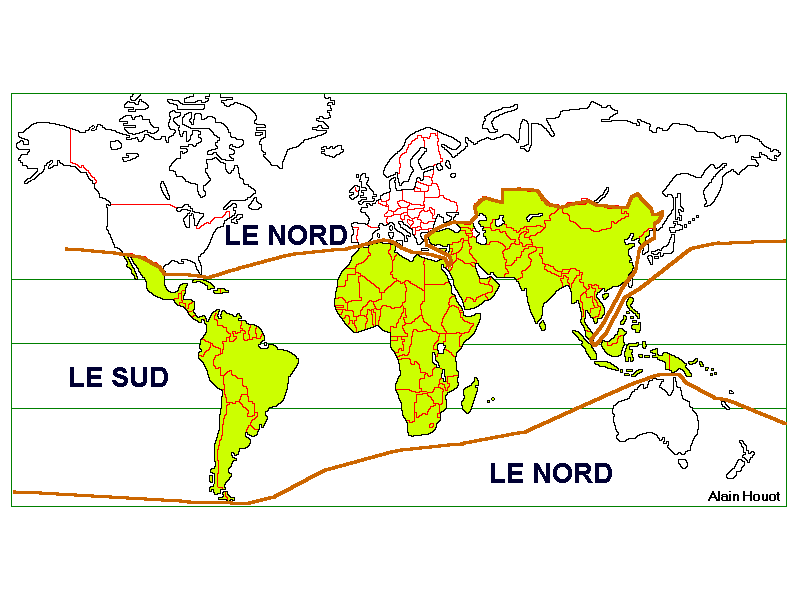
First of all, in France, students don't identify countries in terms of "Western countries," "Eastern countries" or first, second, or third-world countries. They talk about "the northern world" and "the southern world" divided by an imaginary (and in my opinion, rather arbitrary) line that runs along the Mexican-American border, across the ocean, between Europe and Africa, and continues along Russia's southern border all across Asia. With this line, French students distinguish the wealthy, developed "northern world" from the generally poor, underdeveloped "southern world." At first glance, I disliked this categorization of the world; it seemed overgeneralized to me, and I was annoyed that these students were being taught such a black and white view of the world.
After being in the class for a while, though, I'm starting to see the genius of it. The northern/southern categorization isn't used to show a clear split between the rich and the poor, developed and undeveloped; actually, it does just the opposite. Senior year history in France focuses on recent world history. Generally from the mid/late cold war to modern day, with emphasis on globalization and its impact on the world. That's where the northern/southern line comes in. Historically, it has been possible to classify the world in such black and white terms. Even before the cold war, less than a hundred years ago, one could pretty easily sort every country in the world into a "developed" or "undeveloped" category, and the barrier between the developed and undeveloped ran roughly along this north/south line students are taught in school today. In the twenty-first century, with globalization on the rise and the world becoming ever more interconnected and interdependent, this is no longer the case.
Some of the tests we take in history class are "map tests," and are nothing like a history test I ever took back at home. On these tests, we're asked to color code a map based on GDP, life expectancy, even the number of iPhones per capita- and using these telling demographics, we examine which countries are inconsistent with the traditional north/south split and why our color-coded maps look the way they do. It's actually quite fascinating.
Also, now that my French has gotten a lot better since I first showed up here, I'm participating a lot more in class too- and I think both my teacher and classmates are genuinely interested in what I have to say. I've already given myself a mental pat on the back for at least having some idea of what's going on in my country (many exchange students, and many high school students in general, really don't...), which has allowed me to (diplomatically) explain to my class America's position on intervention in Syria, and after which, my history teacher said she was impressed by my knowledge and that she wanted to take a few minutes in class some other time to have me talk to my classmates about September 11th and its consequences on America.
Long story short, it's fun and eye-opening to see the way another country perceives history and geography, and people everywhere generally do appreciate hearing another perspective on world events and conflicts. In a class full of interested, open-minded peers, it's good to be an exchange student. :)

No comments:
Post a Comment